
There is a noticeable difference between placing a table in a room and designing a table specifically for that room.
A dining table may have the right general dimensions and still feel disconnected from its surroundings. The proportions might be slightly off, the edge profile may not complement the architecture, or the base may compete visually with other features in the space. These details can seem small individually, but together they determine whether a table simply occupies the room or genuinely belongs there.
At Rough Around the Edges, we believe custom table design is about much more than choosing a length, width, and wood finish. Every decision contributes to how the finished table looks, feels, and functions within the home.
We create handcrafted custom dining tables, solid wood tables, live edge tables, epoxy river tables, round tables, and rectangular tables for homeowners throughout Ottawa, Kanata, Nepean, Orléans, Barrhaven, Stittsville, Manotick, Carp, Rockland, Russell, Kemptville, and communities across Canada.
Here are some of the details that can transform a custom table from a beautiful piece of woodworking into something that feels completely at home in its surroundings.
It Starts With Understanding the Room
Before thinking about individual design details, it is important to understand the space where the table will live.
A dining area in a contemporary Kanata home may have completely different requirements from a dining room in an older Ottawa property. A spacious home in Manotick might accommodate a substantial rectangular table, while a more compact dining area in Nepean could benefit from a different approach.
Important considerations include the room’s:
- Dimensions
- Shape
- Ceiling height
- Doorways
- Windows
- Natural light
- Walking paths
- Architectural features
Looking at the entire environment helps determine what type of table will feel visually appropriate.
The goal isn’t simply to fit the table into the available floor space. It is to create the right relationship between the table and everything around it.
Proportion Can Change the Entire Appearance
Two tables can technically fit the same dining room while creating completely different impressions.
A substantial tabletop can give a large room visual presence and help anchor an open-concept space. In another home, a lighter profile may create a more open feeling and prevent the dining area from becoming visually crowded.
Length and width are only part of proportion.
The thickness of the tabletop, scale of the base, distance between structural elements, and relationship between the table and surrounding space all contribute to the final appearance.
Custom craftsmanship provides the flexibility to consider these details together rather than treating them as separate decisions.
The Edge Profile Has More Influence Than Many Homeowners Expect
The edge of a tabletop might seem like a minor detail until different options are viewed side by side.
It can significantly influence the personality of the finished table.
A clean, refined edge can support a contemporary aesthetic. A more substantial profile may create a strong architectural presence. A natural live edge celebrates the original character of the hardwood and produces an organic appearance that can never be perfectly duplicated.
At Rough Around the Edges, the edge treatment is considered as part of the overall table design.
The right choice should complement the hardwood, proportions, base, and surrounding interior.
Natural Wood Grain Becomes Part of the Design
Solid wood isn’t a perfectly uniform material—and that is one of its greatest strengths.
Every piece contains natural variations that give it individuality.
Depending on the hardwood, a tabletop may feature:
- Sweeping grain patterns
- Subtle tonal changes
- Natural knots
- Organic markings
- Distinctive figuring
These characteristics mean that even two tables built to identical dimensions would never be truly identical.
Rather than viewing natural variation as something to eliminate, handcrafted table design can use it as part of the visual composition.
The wood itself becomes one of the most important design elements.
Table Bases Deserve Just as Much Attention
The tabletop naturally attracts attention, but the base has a major influence on both appearance and usability.
A well-designed base needs to support the tabletop while also considering legroom, seating positions, visual balance, and the overall character of the table.
The scale is especially important.
A base that appears too small may look visually disconnected from a substantial solid wood top. An overly heavy base can dominate a more refined tabletop.
Because the table is designed as one complete piece, these elements can be considered together from the beginning.
Round Tables Require Their Own Design Approach
A custom round table creates a very different visual and social experience from a rectangular design.
The absence of corners creates continuous movement around the tabletop and can soften rooms dominated by straight architectural lines.
Round tables can work particularly well in:
- Square dining rooms
- Breakfast areas
- Open spaces requiring a softer focal point
- Rooms where circulation is important
However, the relationship between diameter, base design, and seating needs careful consideration.
A custom approach allows these elements to be balanced specifically for the room rather than relying on standardized dimensions.
Rectangular Tables Can Emphasize Architecture
Rectangular dining tables remain a natural choice for many Canadian homes because they work beautifully with elongated rooms and open-concept layouts.
Their linear form can reinforce architectural lines and provide a strong visual anchor.
The customization possibilities go far beyond choosing a length.
Width, tabletop thickness, edge treatment, hardwood character, and base proportions can completely change how a rectangular table feels.
A long table with strong natural grain may create a dramatic statement, while a cleaner design can produce a quieter, more contemporary result.
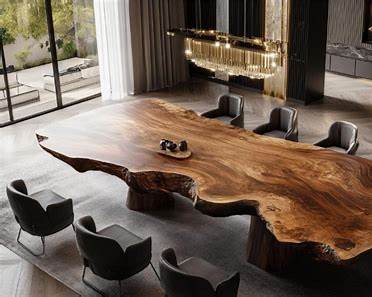
Live Edge Tables Bring Organic Detail Indoors
A live edge preserves the natural contours of the wood rather than cutting the tabletop into completely uniform lines.
The result creates an immediate connection to the material’s natural origin.
Every curve is different.
Every irregularity contributes to the table’s identity.
This makes live edge tables particularly appealing for homeowners who want their dining area to include an authentic natural element.
A live edge can also create an interesting contrast inside contemporary Ottawa homes where much of the architecture consists of smooth surfaces and straight lines.
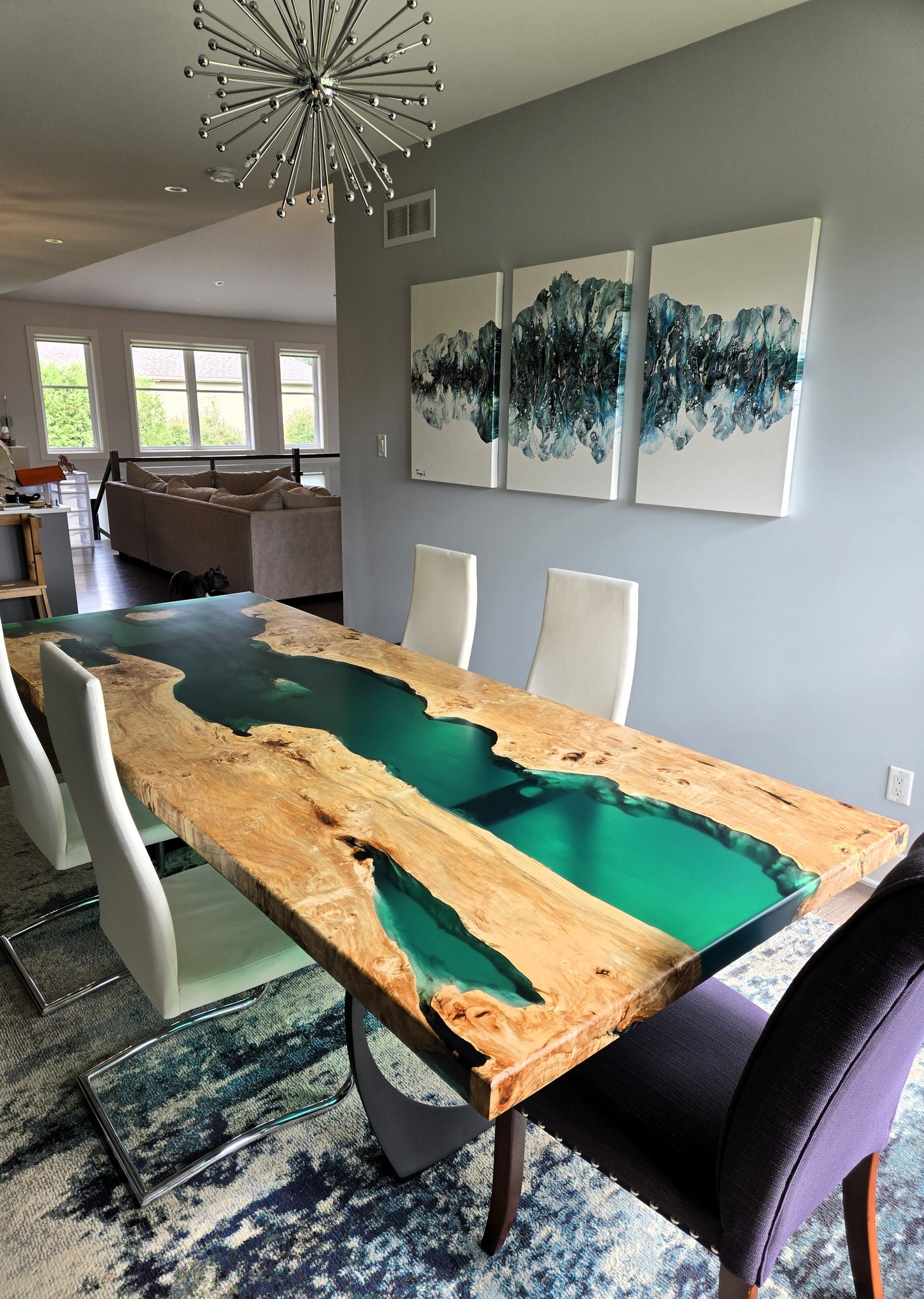
Epoxy Can Be Used as a Deliberate Design Element
An epoxy river table offers another opportunity for personalization.
Rather than treating epoxy as decoration added after the fact, it can become part of the overall composition.
The relationship between hardwood and epoxy determines whether the finished table feels understated, dramatic, contemporary, or artistic.
The most successful designs allow both materials to complement one another.
Natural wood remains an important visual feature while epoxy introduces contrast, depth, and individuality.
Because the hardwood itself is unique, every epoxy river table naturally develops its own appearance.
Finish Changes More Than Colour
The finish applied to a handcrafted table affects how the wood is experienced visually.
It can influence:
- Grain definition
- Colour depth
- Surface appearance
- Overall warmth
- Relationship with surrounding materials
The right finish helps reveal the character already present in the hardwood.
It should also complement the environment where the table will be placed.
A dining space with lighter materials may call for a different visual treatment than a room featuring darker floors or dramatic architectural elements.
Custom design makes it possible to consider these relationships before the table is completed.
Small Decisions Create a Cohesive Final Result
What makes a custom table special is rarely one dramatic feature.
More often, it is the combination of carefully considered details.
The tabletop proportions work with the room.
The base complements the top.
The edge treatment supports the design.
The hardwood contributes natural character.
The finish highlights the grain.
The dimensions support everyday use.
When these decisions are considered together, the table feels cohesive rather than assembled from unrelated choices.
That is where thoughtful customization makes a meaningful difference.
Custom Design Allows the Table to Belong to the Home
One of the greatest advantages of commissioning a handcrafted table is the opportunity to create something specifically for its surroundings.
Homes throughout Ottawa and across Canada vary enormously.
A modern home in Stittsville may require a very different table from a country property near Carp. A dining room in Rockland might inspire different proportions from an open-concept space in Barrhaven. Homes in Russell, Kemptville, Manotick, Kanata, Nepean, and Orléans each present their own architectural possibilities.
Custom craftsmanship allows the table to respond to those differences.
Instead of asking whether a pre-made table will work, homeowners can begin by asking what table would work best.
A Table Should Look Good From Every Direction
Dining tables are increasingly visible from multiple areas of the home, particularly in open-concept layouts.
The table might be seen from the kitchen, living area, hallway, or entrance.
That makes three-dimensional design increasingly important.
The tabletop may be the most noticeable feature from above, while the base becomes more prominent from across the room.
Every angle contributes to the finished appearance.
Thoughtful custom design takes those different viewpoints into consideration.
Details Become More Important Over Time
Bold features may attract attention immediately, but carefully executed details are often what homeowners continue appreciating years later.
It might be the way the natural grain travels across the tabletop.
The way the edge catches afternoon light.
The relationship between the base and the wood.
The subtle character that becomes more noticeable with everyday use.
These are qualities that don’t depend on temporary decorating trends.
They come from materials, proportion, craftsmanship, and thoughtful design.
Handcrafted Tables for Ottawa and Across Canada
At Rough Around the Edges, we focus exclusively on creating tables.
Our work includes custom dining tables, live edge tables, epoxy river tables, solid wood tables, round tables, rectangular tables, and individually designed handcrafted tables.
This specialization allows us to focus closely on the details that make a table successful.
We proudly work with homeowners throughout Ottawa, Kanata, Nepean, Orléans, Barrhaven, Stittsville, Manotick, Carp, Rockland, Russell, Kemptville, and communities across Canada.
Every project begins with a different space, different piece of hardwood, and different vision.
The result should feel equally individual.
Create a Table That Feels Like It Was Always Meant for Your Home
A truly custom table isn’t defined by one feature.
It is the result of dozens of thoughtful decisions working together—from proportions and hardwood character to edge treatment, base design, finish, and everyday functionality.
When those details are considered from the beginning, the finished table doesn’t simply fill an empty dining area.
It belongs there.
If you’re considering a custom dining table, live edge table, epoxy river table, round table, rectangular table, or handcrafted solid wood table, our team at Rough Around the Edges would be pleased to help create a design specifically for your home.
We proudly serve Ottawa, Kanata, Nepean, Orléans, Barrhaven, Stittsville, Manotick, Carp, Rockland, Russell, Kemptville, and communities throughout Canada.
Ready to Begin Your Custom Table?
Call Rough Around the Edges at (343) 500-7325 to discuss your ideas and begin creating a handcrafted table designed around your space, your style, and the way your household lives every day.