
When someone contacts me at Rough Around the Edges about a live edge table, the very first step is choosing the right slab. This is one of the most exciting parts of the process, and honestly, it’s where the personality of your table begins to show. Whether you’re in Ottawa, Toronto, Montreal, or the surrounding areas, selecting the perfect slab is what makes a table truly one-of-a-kind.
Why the Slab Matters So Much
- Natural uniqueness
No two slabs are identical. The grain pattern, knot structure, sapwood vs heartwood, figure, bark inclusion, cracks, and color variation all give your table its story. The slab is your foundation — everything else is built around it. - Structural considerations
The slab’s shape, thickness, and integrity (e.g. splits, checks, voids) influence what kind of reinforcement or joinery we need. A beautiful slab with a flaw will require bridging, resin, or dutchmen, which affects cost and design. - Workability & finishing
Some slabs plane and flatten easily; others demand extra prep. The moisture content, drying history, or internal stress of the slab all affect how stable it will be over time and how it will accept finishes. - Size, scale & layout
The shape of the slab may guide how long, wide, or wide overhangs your table can be. You might love a dramatic live edge flare or a subtle mirrored edge — the slab dictates those possibilities. - Emotional connection
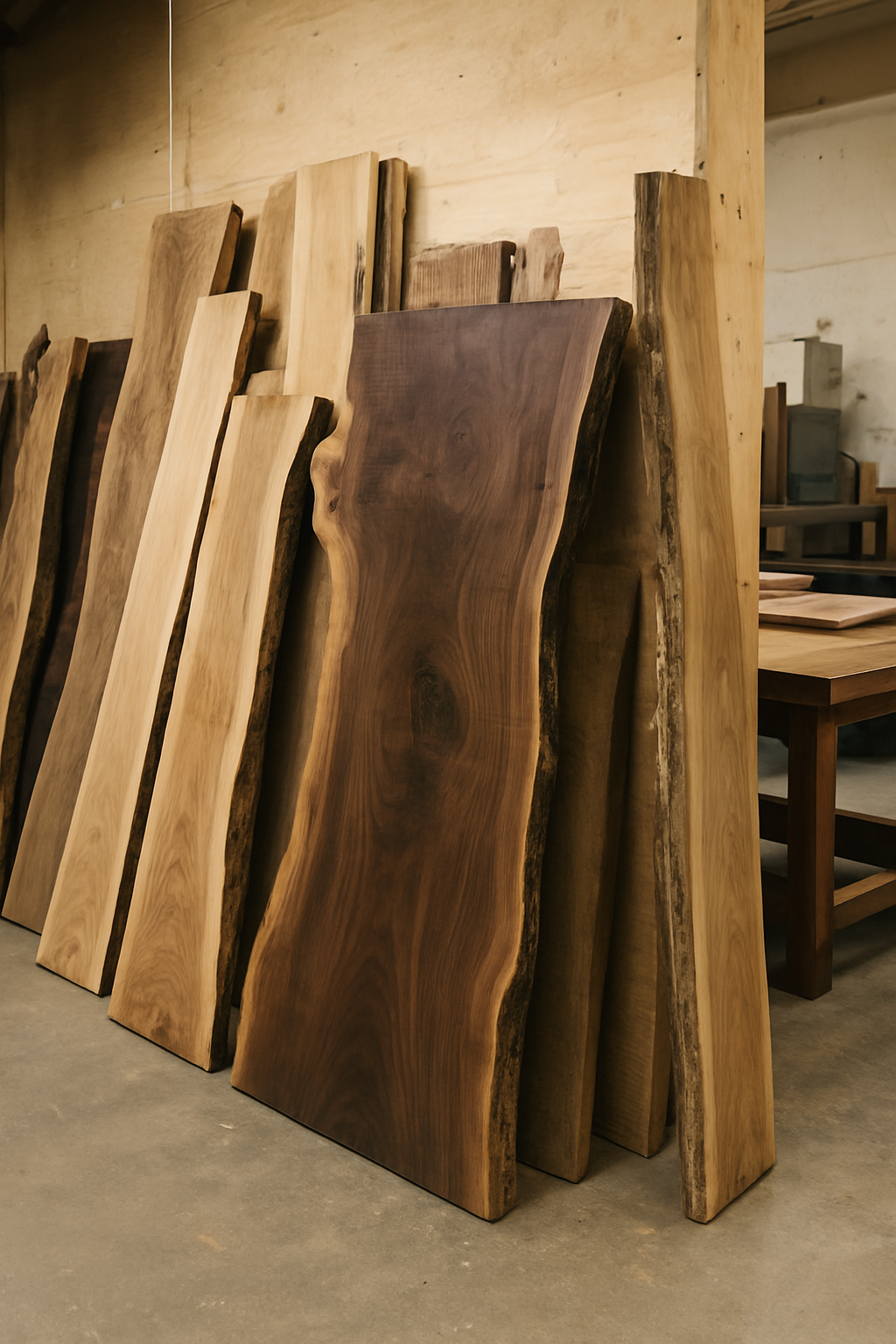
Many clients tell me that when they walk into the shop and see the slab in person, touch it, see its grain, feel its weight, that’s when they “fall in love” with their table. That first connection often becomes a guiding light through the entire build.
What We Look at When Picking Slabs
When selecting a slab with a client, here are the key criteria we evaluate:
- Grain & figure — Does the slab have features like swirling grain, cathedral patterns, spalting, burl, or curly figure? These dramatic elements often become focal points.
- Thickness & thickness uniformity — A slab with consistent thickness is easier to work with; if thickness varies, we may need to plane or build up areas.
- Defects, checks, voids, cracks — We assess what’s repairable (resin, inlays, dutchmen) vs. what might compromise stability.
- Drying & moisture content — Ideally, the slab is well-dried (or kiln-dried) to reduce warping / movement.
- Edge shapes / bark / natural edge features — Some clients want a full bark edge; others prefer a more controlled live edge. We evaluate what is salvageable and attractive.
- Dimensions & usable width — We check how wide the usable part of the slab is (sometimes edges or defects must be trimmed).
- Color & contrast — The balance between lighter sapwood and darker heartwood, or contrast bands, often helps dictate finish choices.
Understanding the Wood
Every type of wood has its own story. Black walnut, maple, and oak are my favorites for Rough Around the Edges tables because they balance durability, beauty, and character. Black walnut has that deep, rich tone that really pops in a dining room. Maple is lighter and elegant, giving a space a warm, airy feel. Oak is classic, with grain patterns that are bold and full of movement.
When I pick a slab, I look at the grain, color, and figure. The grain tells a story about the tree’s life, knots, waves, and natural edges make each piece unique. Some slabs draw you in immediately, while others grow on you the more you study them.
Size and Proportion Matter
A slab isn’t just about beauty, it needs to fit your space. I measure the room, consider the number of seats, and visualize how the table will feel in daily use. In Ottawa and Toronto, I often work with clients who have open-concept living spaces, so I select wider slabs that feel substantial without overwhelming the room. For Montreal lofts, slimmer slabs with elegant curves work beautifully.
Natural Character vs. Flaws
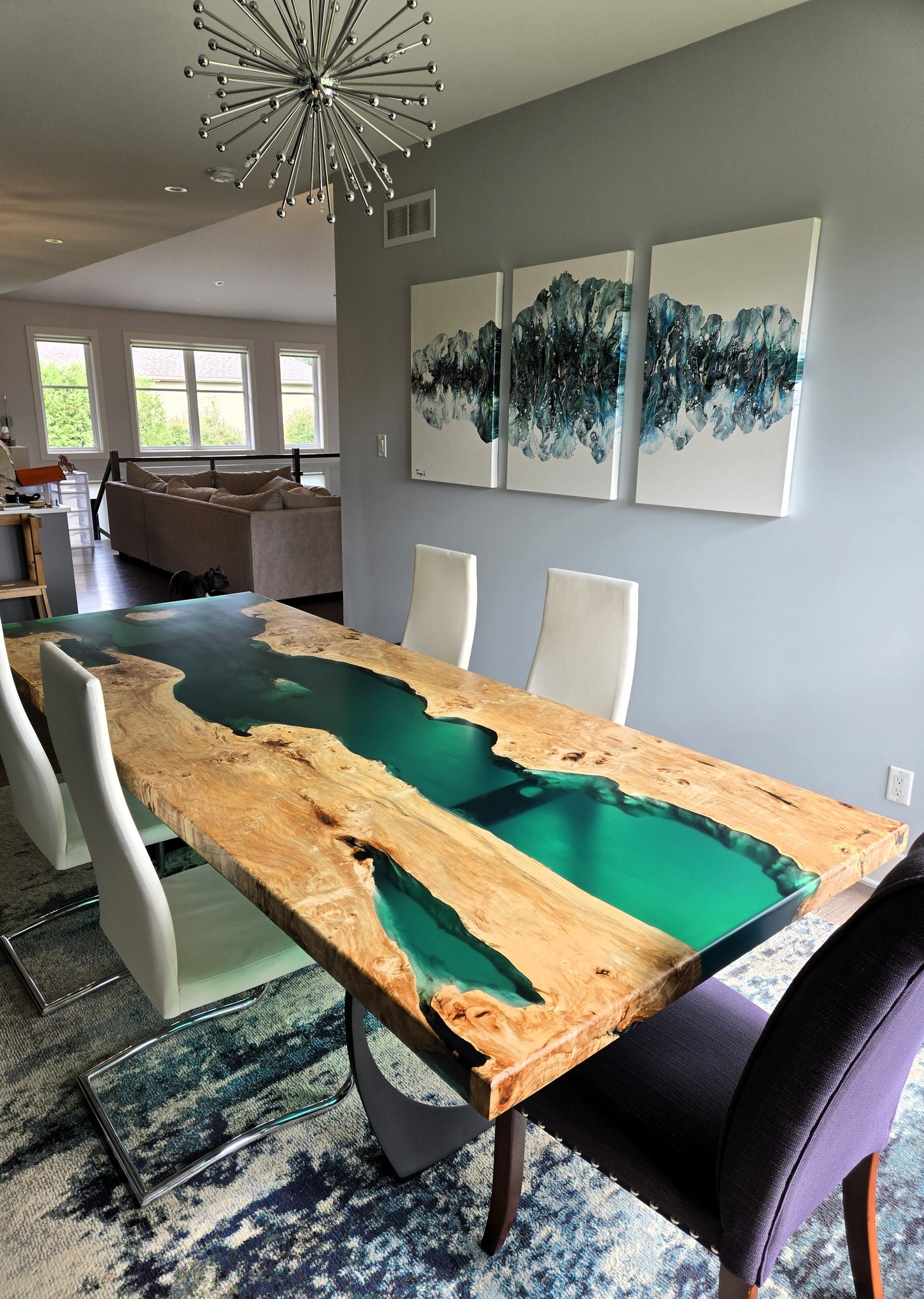
I love slabs with natural character, but there’s a fine line between a feature and a flaw. I examine cracks, checks, and knots to see how they can be stabilized and highlighted. I often use epoxy to reinforce and accentuate these natural details, turning what might be a “flaw” into a signature feature of the table.
Matching Your Vision
When I meet with clients, I listen closely to the look and feel they want. Do you want a rustic, dramatic statement or something more understated? Some clients love the dark richness of walnut paired with a metal base, while others want the light warmth of maple with a hand-carved wooden base. Your slab sets the tone for the entire piece, and I make sure it aligns perfectly with your vision.
Why This Step is So Important
Choosing the slab isn’t just picking a piece of wood — it’s selecting the soul of your table. Every cut, every curve, every knot will influence the finished piece. This is why I take the time to walk clients through the options, share the slabs in person when possible, and explain how each choice will translate into the final table.
Bringing Your Vision to Life
The slab you choose becomes the heartbeat of your custom live edge table. Once we’ve locked in that foundation, the rest of the design — joinery, legs, finish, movement allowances, revolves around making the slab shine and perform beautifully over time.
If you’re ready to browse slabs, view options, and start designing your live edge table in the Ottawa / Toronto / Montreal region, I’d love to guide you. Reach out today, tell me your space, style, and what you hope to see, and let’s pick the slab that will start the story of your custom table.
Contact me today to select your perfect slab and start your custom table journey.