
One of the most common questions homeowners face when choosing a solid wood dining table is surprisingly simple:
Does the table need to match the wood flooring?
The short answer is no.
In fact, trying to match every wood surface perfectly can sometimes make a dining space feel flatter and less natural. A beautifully designed room often contains several tones, textures, and materials that complement one another without being identical.
For homeowners considering a custom dining table, this creates an exciting opportunity. Instead of searching for a table that happens to be close to the colour of the floor, the hardwood, finish, proportions, and overall character of the table can be selected to create an intentional relationship with the surrounding space.
At Rough Around the Edges, we specialize exclusively in handcrafted tables, including solid wood tables, live edge tables, epoxy river tables, round tables, rectangular tables, and fully customized dining tables.
We proudly serve homeowners throughout Ottawa, Kanata, Nepean, Orléans, Barrhaven, Stittsville, Manotick, Carp, Rockland, Russell, Kemptville, and communities across Canada.
When it comes to combining wood flooring and a custom table, the goal is not necessarily matching.
The goal is balance.
Why Exact Wood Matching Isn’t Necessary
Natural wood is filled with variation.
Even within the same type of hardwood, two pieces can display differences in:
- Grain
- Colour
- Figure
- Natural markings
- Light and dark areas
- Overall character
That means expecting a dining table to look exactly like an existing hardwood floor may not even be realistic.
More importantly, it is usually unnecessary.
The dining table and flooring perform completely different visual roles.
The floor provides a large background surface extending throughout the room, while the table is a defined three-dimensional object.
Allowing some distinction between them can actually make the table easier to appreciate.
Contrast Can Make a Solid Wood Table Stand Out
Imagine a dining room with relatively light wood flooring.
Placing another wood surface of almost exactly the same tone above it can create a very uniform appearance.
A custom table with greater tonal depth can establish clearer visual separation.
The opposite can also work.
A room with darker flooring may benefit from a table with a lighter or more varied natural appearance.
Contrast allows each material to retain its own identity.
Rather than disappearing into the floor, the table becomes a recognizable focal point.
Coordination Is Different From Matching
This distinction is important.
Matching attempts to make two surfaces look the same.
Coordination considers how two different surfaces look together.
A coordinated dining space can include multiple wood tones as long as they feel intentional.
Homeowners can consider characteristics such as:
- Warm versus cooler undertones
- Light versus dark values
- Grain intensity
- Natural variation
- Finish appearance
- Visual weight
These relationships can be more important than finding an exact colour match.
Start With the Floor Because It Is Already There
In many homes, the flooring is one of the largest permanent surfaces.
Unless a renovation is planned, it becomes part of the environment the custom table needs to work within.
This does not mean the floor dictates every decision.
Instead, it provides useful context.
A homeowner might look at the floor and ask:
Is it visually busy or relatively quiet?
Does it contain significant colour variation?
Is the overall appearance light, medium, or dark?
Does the grain strongly influence the room?
Once these qualities are understood, it becomes easier to determine whether the custom table should create contrast or continuity.
Light Wood Floors Offer Plenty of Possibilities
Light flooring can create a bright, open atmosphere.
It can also provide an excellent background for natural hardwood tables.
A table with richer colour can become visually grounded against a lighter floor.
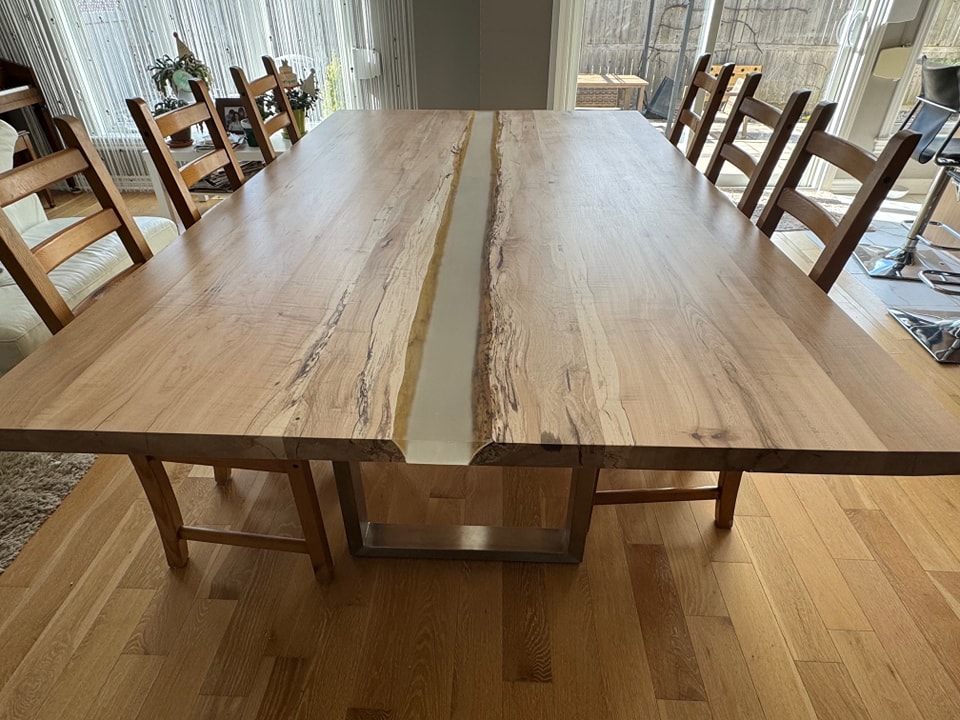
A live edge tabletop can introduce organic movement.
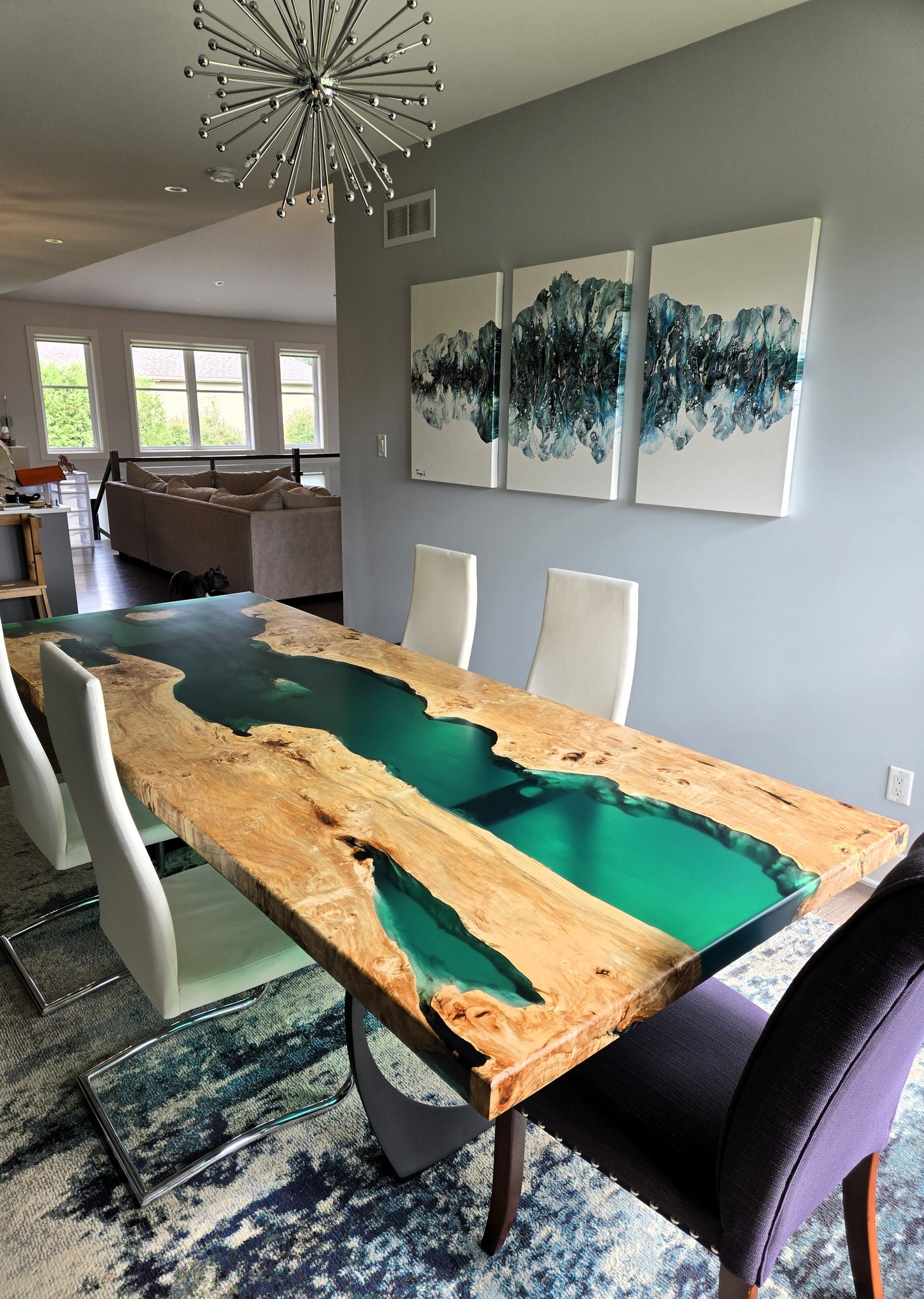
An epoxy river table can add a dramatic point of interest.
Alternatively, a lighter table can maintain the airy character of the room while using grain and natural variation to create enough distinction.
The right approach depends on the architecture and the homeowner’s preferred atmosphere.
Dark Floors Can Create a Dramatic Foundation
Darker flooring establishes visual weight at the bottom of the room.
A custom solid wood table can respond in several ways.
A contrasting table can create separation and make the hardwood surface more prominent.
A deeper-toned table can create a richer, more dramatic overall environment.
Neither approach is automatically correct.
The important factor is ensuring the table does not visually disappear.
Natural grain, edge character, base design, and the way light interacts with the surface can all help maintain definition.
Medium Wood Tones Require Careful Comparison
Medium-toned floors can sometimes be the most interesting to work with because they sit between very light and very dark finishes.
A table that is only slightly different may appear as though it was intended to match but missed.
Creating clearer contrast can often feel more deliberate.
Alternatively, choosing hardwood with significant natural variation can establish distinction through grain and character rather than colour alone.
This is one reason physical wood character matters.
A table should be evaluated as a natural material, not simply as a colour sample.
Grain Direction Creates Another Layer of Contrast
Colour is only one part of the relationship.
Grain also influences how two wood surfaces interact.
Floorboards usually create repeated linear patterns across a room.
A solid wood tabletop introduces grain on a different scale.
A large slab may contain sweeping movement, knots, figuring, and natural changes in direction.
This difference can create visual interest even when the floor and table share similar general tones.
A rectangular custom table can reinforce the direction of a room, while the natural grain keeps the tabletop from feeling repetitive.
Live Edge Tables Naturally Create Separation
A live edge dining table has an advantage when placed over wood flooring: its organic perimeter immediately distinguishes it from the repeated geometry below.
Most wood floors are installed in consistent straight boards.
A live edge does the opposite.
It preserves natural curves and irregularities.
That contrast makes it clear that the tabletop is not simply another wood surface.
It is an individual piece of hardwood with its own natural history.
This can work particularly well in homes throughout Manotick, Carp, Kemptville, and other Canadian communities where homeowners want to combine contemporary interiors with natural character.
Epoxy Creates an Additional Material Contrast
An epoxy river table introduces another dimension to rooms that already contain significant amounts of wood.
Instead of placing wood over wood alone, epoxy creates visual separation within the tabletop itself.
The contrast between the hardwood and epoxy can help define the table against flooring.
This can be especially effective in interiors where homeowners want natural material without creating an overwhelmingly wood-dominated appearance.
The hardwood remains prominent, but the epoxy adds depth and individuality.
Round Tables Break Up Linear Flooring
Wood floors naturally create lines.
Kitchen cabinetry creates more lines.
Walls, windows, islands, and doorways usually add even more rectangular geometry.
A round custom table can provide a welcome visual interruption.
Its circular perimeter contrasts with the straight flooring beneath it, immediately defining the dining area.
This can be especially effective in open-concept homes throughout Ottawa, Kanata, Barrhaven, and Stittsville, where different functional zones share one continuous floor.
The table’s shape helps establish the dining area without requiring walls or other physical divisions.
Rectangular Tables Can Reinforce Architecture
In other homes, homeowners may prefer to work with the existing geometry rather than contrast it.
A rectangular solid wood table can align beautifully with long floorboards, a kitchen island, or the overall direction of an open-concept space.
This creates visual continuity.
Natural grain then provides enough organic variation to keep the design from becoming overly rigid.
Custom dimensions allow the table’s proportions to relate directly to the architecture rather than simply following standard furniture measurements.
Don’t Forget the Table Base
When coordinating a custom table with flooring, homeowners often concentrate entirely on the tabletop.
However, the base sits much closer to the floor and can have a strong visual relationship with it.
Depending on the design, the base can provide contrast between the two wood surfaces.
It can also help visually ground the tabletop.
Because the base is visible beneath the table from many angles, it should be considered as part of the entire composition rather than an afterthought.
Rugs Change the Relationship
Some homeowners place a rug beneath the dining table.
When that happens, the direct visual connection between the hardwood tabletop and flooring is reduced.
The rug introduces another layer between them.
This can give homeowners additional freedom when selecting the table because the floor no longer sits immediately beneath the base from every viewing angle.
However, the table still needs to work with the broader room.
From entrances, adjoining spaces, and other sightlines, the flooring remains part of the visual environment.
Kitchen Materials Matter Too
In open-concept homes, the dining table often sits near the kitchen.
That means flooring is only one of several permanent materials influencing the space.
The table may also be viewed alongside:
- Kitchen cabinetry
- Countertops
- Backsplash materials
- Kitchen islands
- Architectural wood details
Trying to match every material would be nearly impossible—and unnecessary.
Instead, the custom table can become the element that brings warmth, contrast, and natural character into the larger composition.
Natural Light Can Change Both the Floor and Table
Colour should never be considered without lighting.
A wood floor can appear noticeably different in bright daylight than it does in the evening.
The same is true of a solid wood tabletop.
Large windows may reveal warm tones during one part of the day and emphasize grain during another.
Artificial lighting can change the perceived richness of both surfaces at night.
For homeowners throughout Ottawa, Nepean, Orléans, Rockland, and Russell, where seasonal daylight changes dramatically throughout the year, this is worth considering.
A successful combination should feel appealing under the lighting conditions the room experiences regularly.
Don’t Choose a Table From a Tiny Colour Sample Alone
Small samples can be useful, but natural hardwood needs to be understood on a larger scale.
A tiny section cannot fully communicate:
- Grain movement
- Tonal variation
- Knots
- Figure
- Natural transitions
- The overall personality of a slab
A finished table may contain many tones rather than one uniform colour.
This natural variation is exactly what can help it coordinate successfully with an existing floor.
Instead of focusing on whether one small area matches, homeowners can consider how the entire table will interact with the room.
Let the Table Have Its Own Identity
One of the advantages of commissioning a handcrafted table is the opportunity to create something with genuine presence.
That opportunity can be lost if every decision is made solely to imitate existing surfaces.
A custom table should belong in the room, but it does not need to disappear into it.
The hardwood can have its own grain.
The finish can have its own depth.
A live edge can introduce its own organic shape.
An epoxy river can add its own visual movement.
The strongest interiors often allow individual materials to express themselves while maintaining overall harmony.
This Approach Works Across Different Canadian Homes
Homes throughout Ottawa and Canada feature an enormous variety of flooring.
A property in Nepean may contain established hardwood with considerable character.
A newer home in Kanata, Barrhaven, or Stittsville may feature lighter contemporary flooring.
A home in Manotick or Carp may combine natural materials with expansive architectural spaces.
Properties in Orléans, Rockland, Russell, and Kemptville may present entirely different combinations.
There is no single table colour that works for every floor.
Custom craftsmanship makes it possible to respond to the actual home rather than relying on a universal formula.
Rough Around the Edges Creates Tables for Individual Homes
At Rough Around the Edges, tables are our specialty.
We create handcrafted:
- Custom dining tables
- Solid wood tables
- Live edge tables
- Epoxy river tables
- Round tables
- Rectangular tables
- One-of-a-kind custom tables
We proudly serve Ottawa, Kanata, Nepean, Orléans, Barrhaven, Stittsville, Manotick, Carp, Rockland, Russell, Kemptville, and communities throughout Canada.
By considering the hardwood alongside flooring, architecture, natural light, room proportions, and surrounding materials, homeowners can create a table that feels intentional within their particular environment.
Aim for Harmony, Not a Perfect Match
So, should a solid wood dining table match the floor?
Usually, there is no reason it has to.
A dining room can be far more interesting when natural materials complement rather than copy one another.
Light and dark tones can create contrast.
Different grain patterns can add depth.
A round table can break up linear flooring.
A rectangular table can reinforce architectural direction.
Live edge hardwood can introduce organic movement, while epoxy can create an additional layer of visual distinction.
The goal is to step back and consider the room as a whole.
When the relationship feels balanced, the individual wood tones do not need to be identical.
And when the table is handcrafted specifically for the home, it can have something even more valuable than a perfect colour match:
a character of its own.
Create a Custom Table That Complements Your Home
If you’re planning a custom dining table, solid wood table, live edge table, epoxy river table, round table, or rectangular table, Rough Around the Edges can help create a handcrafted design that works beautifully with your home’s flooring, architecture, proportions, and overall character.
We proudly serve homeowners throughout Ottawa, Kanata, Nepean, Orléans, Barrhaven, Stittsville, Manotick, Carp, Rockland, Russell, Kemptville, and communities across Canada.
Call Rough Around the Edges at (343) 500-7325 to discuss your ideas and begin creating a one-of-a-kind custom table designed to complement your home without simply matching everything around it.