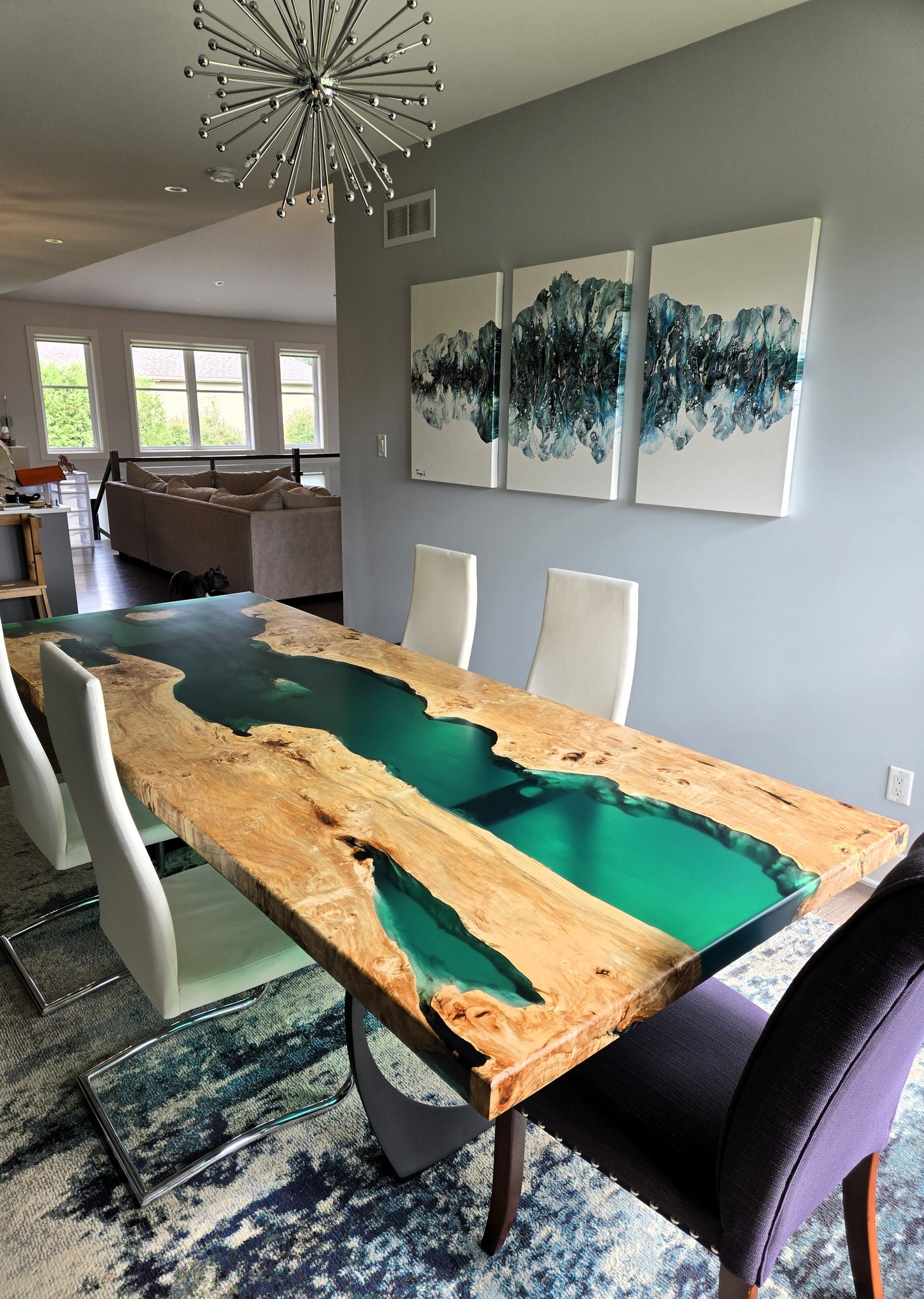


When people imagine a custom dining table, attention naturally goes to the tabletop. The richness of solid hardwood, the movement of the grain, the organic character of a live edge, or the visual depth of an epoxy river can easily become the centre of attention.
But underneath that beautiful surface is another element that deserves just as much consideration: the table base.
A base does much more than support the tabletop. Its proportions influence the overall appearance of the table, its placement affects legroom and seating, and its style can completely change whether the finished piece feels contemporary, substantial, understated, or architectural.
At Rough Around the Edges, we specialize exclusively in handcrafted tables. Our work includes custom dining tables, solid wood tables, live edge tables, epoxy river tables, round tables, rectangular tables, and one-of-a-kind custom tables.
For homeowners throughout Ottawa, Kanata, Nepean, Orléans, Barrhaven, Stittsville, Manotick, Carp, Rockland, Russell, Kemptville, and communities across Canada, understanding the role of the base can make it easier to create a custom table that works beautifully from every angle.
Why the Table Base Deserves More Attention
The tabletop may be the first thing people notice, but the base has a significant influence on how the entire table is perceived.
Imagine the same solid wood tabletop placed on two completely different bases.
One might create a clean, contemporary appearance.
The other could make the table feel heavier and more substantial.
The hardwood has not changed.
The dimensions have not changed.
Yet the personality of the finished table can be dramatically different.
This is why a custom table should be designed as one complete composition rather than treating the tabletop and base as unrelated decisions.
The Base Has Three Jobs
A successful table base generally needs to accomplish three things at the same time.
It should provide appropriate structural support.
It should allow people to sit comfortably.
And it should visually complement the tabletop.
If any one of those elements is ignored, the table may not feel completely resolved.
A visually dramatic base is not particularly successful if guests constantly bump their knees against it.
Likewise, a functional base that appears too small beneath a substantial hardwood top can make the entire design feel visually unbalanced.
Custom craftsmanship allows these priorities to be considered together.
Visual Weight Matters
Every table has visual weight.
A thick solid wood tabletop naturally feels more substantial than a visually lighter top.
The base should respond accordingly.
A base that is too delicate can appear disconnected from a heavy slab. An excessively large base can overwhelm a more refined tabletop and draw attention away from the hardwood.
The objective is balance.
This does not mean the base and tabletop must look equally heavy. Contrast can create an excellent design.
However, that contrast should feel deliberate.
When proportions are carefully considered, the base appears to belong beneath the tabletop rather than looking like an element chosen afterward.
Base Placement Influences Seating
This is where aesthetics and everyday function meet.
Where the supports are positioned determines where chairs can comfortably go.
If the base extends too far toward the ends of a rectangular table, it can restrict end seating.
If supports interfere with chair placement along the sides, a table that appears large enough for several people may actually provide fewer comfortable seating positions.
These details become especially important for households that regularly entertain.
A homeowner may want a custom table that accommodates immediate family every day while providing additional seating during holidays or celebrations.
The base should support those plans rather than work against them.
Think About Knees, Feet, and Chairs
Table design should be considered from the seated position, not only from across the room.
When someone sits down, there needs to be comfortable space for their knees and feet.
Dining chairs also need enough room to move naturally.
A visually striking base can quickly become frustrating if it constantly interferes with normal movement.
That is why legroom should be part of the design process from the beginning.
At Rough Around the Edges, the goal is to create handcrafted tables that are genuinely enjoyable to use, not simply attractive to photograph.
Rectangular Tables Offer Many Base Possibilities
A rectangular custom dining table provides significant flexibility because the base can interact with the tabletop in many different ways.
The length of the table creates a strong horizontal line, while the base introduces vertical and structural elements beneath it.
The relationship between these forms can produce dramatically different appearances.
A clean base can allow expressive hardwood grain to remain the primary focal point.
A more architectural base can become part of the visual statement.
For larger rectangular tables in Ottawa, Kanata, Barrhaven, or Stittsville homes, the base also needs to provide appropriate support without unnecessarily limiting seating.
That balance is one of the reasons custom design is valuable.
Round Tables Require a Different Approach
A round table presents its own structural and aesthetic considerations.
Unlike a rectangular table, there are no corners defining individual seating areas.
People may sit around the entire perimeter.
Because of this, base design becomes especially important.
A poorly positioned base can interfere with multiple seating positions.
A thoughtfully designed central or appropriately configured support can help preserve comfortable legroom while maintaining the visual symmetry of the round tabletop.
The base also affects how the table appears from every direction.
Since a round table has no obvious front or back, every viewpoint matters.
Live Edge Tables Create an Interesting Contrast
A live edge table contains natural curves and irregularities along the hardwood.
The base provides an opportunity either to reinforce that organic character or contrast with it.
A clean geometric base beneath a live edge tabletop can create a striking balance between nature and structure.
The top celebrates irregularity.
The base introduces order.
This contrast works particularly well in contemporary Canadian homes where natural materials are used to soften clean architectural lines.
In homes around Manotick, Carp, Russell, and Kemptville, it can also complement interiors inspired by the surrounding landscape.
Epoxy River Tables Need Visual Balance
An epoxy river table already contains significant visual interest.
The combination of hardwood and epoxy creates movement across the tabletop, making the surface an important design feature.
Because of this, the base should be considered carefully.
If every element competes for attention, the finished table can become visually overwhelming.
Sometimes a restrained base allows the epoxy and natural hardwood to take centre stage.
In other designs, a stronger architectural base can balance a substantial tabletop.
There is no universal answer.
The correct decision depends on the particular table.
That is exactly where customization becomes valuable.
The Base Changes How a Table Looks From Across the Room
People do not always see a dining table from above.
In many homes, especially open-concept layouts, the table is viewed from across the living area or kitchen.
From those angles, the base can become extremely prominent.
The tabletop may appear as a relatively thin horizontal plane while the structure beneath it occupies much of the visible area.
This means the base contributes significantly to how the dining area looks from adjoining spaces.
For homeowners in newer Ottawa, Orléans, Kanata, Barrhaven, and Stittsville properties, where dining rooms frequently share sightlines with other areas, this can be an important consideration.
Open-Concept Homes Put Bases on Display
Traditional dining rooms may hide much of the table behind walls and doorways.
Open-concept homes do not.
A custom table can be visible from:
- The kitchen
- Living room
- Entrance
- Hallway
- Staircase
- Outdoor area
This makes three-dimensional design important.
The table should look intentional from the end as well as the side.
Its base should remain visually balanced from different viewpoints.
Custom craftsmanship allows the table to be considered as an object occupying the entire space rather than simply as a tabletop viewed from one position.
Floor Space Changes How a Base Is Experienced
A table base also interacts directly with the floor.
This relationship becomes especially noticeable on open flooring where the area beneath the table is clearly visible.
The base can create:
- Strong geometric lines
- Visual openness
- A substantial grounded appearance
- Architectural contrast
The flooring material itself may also influence the design.
A base against hardwood flooring creates a different visual relationship than one positioned over stone, tile, or another surface.
The goal does not need to be perfect matching.
Instead, the different elements should feel intentional together.
The Base Can Help a Large Table Feel Lighter
Large solid wood tables naturally have substantial presence.
In some homes, that is exactly the desired effect.
In others, homeowners want generous tabletop space without making the room feel overly heavy.
Base design can influence that perception.
A visually open structure may allow more flooring and light to remain visible beneath the table.
This can reduce the perceived mass of the overall piece even when the tabletop itself is substantial.
The opposite is also possible.
A stronger base can give a large room the visual anchor it needs.
Custom design allows these decisions to respond to the architecture.
Small Dining Areas Benefit From Thoughtful Bases Too
Base design is not only important for large statement tables.
It can be even more critical in smaller dining areas.
When floor space is limited, every seating position matters.
A base that unnecessarily restricts chairs can reduce functionality.
A thoughtfully configured base can help make better use of the available perimeter.
This can be particularly useful in more compact dining rooms throughout Ottawa and Nepean, where maximizing usable space without overcrowding the room may be a priority.
Table Bases Can Create Architectural Character
The base is one of the strongest opportunities to introduce architectural character into a custom table.
Its lines can feel:
- Clean
- Strong
- Minimal
- Substantial
- Contemporary
- Industrial-inspired
- Geometric
These qualities influence the personality of the entire table.
A relatively simple hardwood top can feel completely different depending on what supports it.
This is why homeowners should consider the base as a design feature rather than merely a structural necessity.
The Best Base Supports the Hardwood Rather Than Distracting From It
Natural hardwood already contains remarkable visual detail.
Grain.
Colour variation.
Knots.
Organic markings.
Live edges.
In an epoxy river table, another layer of visual interest is added.
A successful base helps present these features.
Sometimes that means creating contrast.
Sometimes it means remaining deliberately understated.
The best solution is the one that allows the table to feel balanced as a complete piece.
Think About the Table With Chairs Around It
It is easy to evaluate a table base when looking at an empty table.
But that is not how the table will usually appear in the home.
Dining chairs will surround it.
People will sit around it.
The chairs themselves introduce additional lines, shapes, and visual weight.
A base that looks very prominent when the table is empty may become more subtle once chairs are added.
Likewise, certain support positions may interfere with chair placement in ways that are not immediately obvious without considering the complete seating arrangement.
Designing around real use produces better results.
Canadian Homes Require Tables Built for Real Life
Throughout Canada, dining tables serve many purposes.
They support family dinners, entertaining, celebrations, schoolwork, conversations, and everyday routines.
A base needs to remain dependable throughout all of those activities.
For solid wood tables, construction also needs to respect the natural characteristics of hardwood and the seasonal environmental changes experienced in Canadian homes.
Long-term performance should therefore be considered alongside visual design.
The table needs to look right.
But it also needs to work.
A Custom Base Helps Make the Entire Table Personal
Customization is not limited to choosing a beautiful slab of hardwood.
The relationship between the tabletop and base can make the finished table much more individual.
Homeowners can create a table whose structure responds to:
- Room dimensions
- Table shape
- Seating requirements
- Hardwood character
- Architectural style
- Desired visual weight
- Everyday lifestyle
These decisions work together to create something that could not simply be selected from a predetermined catalogue.
Rough Around the Edges Specializes Exclusively in Tables
At Rough Around the Edges, our focus is handcrafted custom tables.
We create:
- Custom dining tables
- Solid wood tables
- Live edge tables
- Epoxy river tables
- Round tables
- Rectangular tables
- One-of-a-kind handcrafted tables
We proudly serve homeowners throughout Ottawa, Kanata, Nepean, Orléans, Barrhaven, Stittsville, Manotick, Carp, Rockland, Russell, Kemptville, and communities across Canada.
Every table presents its own combination of dimensions, materials, seating requirements, architecture, and design preferences.
The base is an important part of bringing all those elements together.
Look Under the Table Before Making the Final Decision
When designing a custom table, it is worth spending as much time thinking about what happens underneath the tabletop as what happens above it.
Will everyone have comfortable legroom?
Can chairs be positioned where they are needed?
Does the base provide the right visual balance?
How will it look from adjoining rooms?
Does it complement the natural hardwood?
Does its scale suit the tabletop?
These questions may not be as exciting initially as selecting a beautiful slab or imagining an epoxy river, but they can make an enormous difference in how the finished table performs every day.
A great table base should provide strength without becoming an obstacle.
It should contribute character without overwhelming the hardwood.
Most importantly, it should help the entire table feel as though every detail was designed together.
Because with a genuinely custom table, it was.
Ready to Design Your Custom Table From Top to Bottom?
If you’re considering a handcrafted custom dining table, solid wood table, live edge table, epoxy river table, round table, or rectangular table, Rough Around the Edges can help create a design where the tabletop, base, proportions, and everyday functionality work beautifully together.
We proudly serve homeowners throughout Ottawa, Kanata, Nepean, Orléans, Barrhaven, Stittsville, Manotick, Carp, Rockland, Russell, Kemptville, and communities across Canada.
Call Rough Around the Edges at (343) 500-7325 to discuss your ideas and begin creating a one-of-a-kind handcrafted table designed from every angle for your home and the way you live.