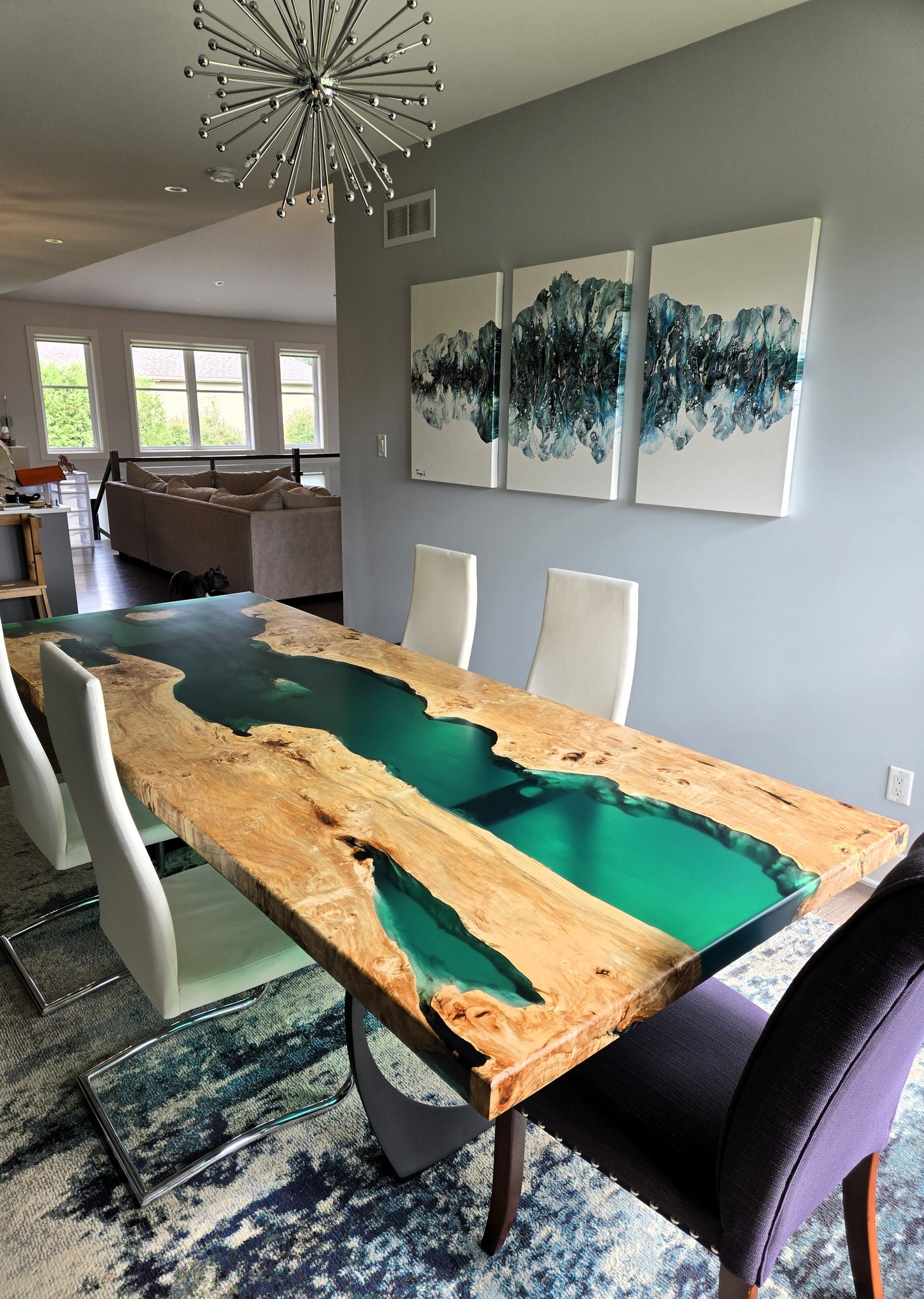

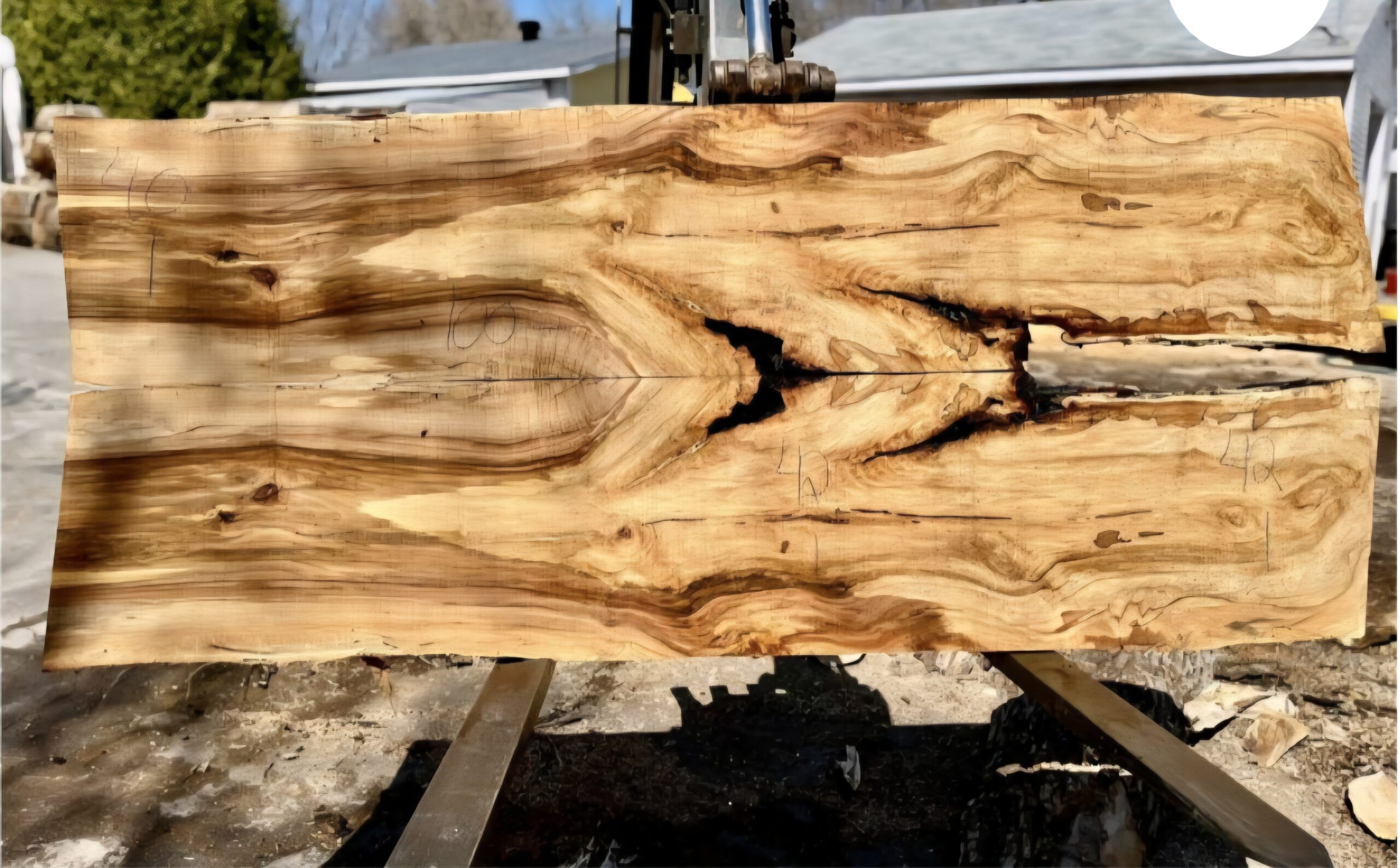
Before a handcrafted table receives its final finish, before chairs surround it, and before it becomes part of everyday life in a home, the hardwood already has a design of its own.
That design is found in the grain.
Wood grain is much more than a pattern on the surface. It can sweep dramatically across a tabletop, form subtle lines that become more noticeable in natural light, curve around knots and other features, or change character from one section of a slab to another. It is one of the reasons two solid wood tables can never be completely identical.
At Rough Around the Edges, we specialize exclusively in handcrafted tables, including custom dining tables, solid wood tables, live edge tables, epoxy river tables, round tables, and rectangular tables. Working with natural hardwood means allowing the individual character of the material to become an important part of every finished design.
We proudly create custom tables for homeowners throughout Ottawa, Kanata, Nepean, Orléans, Barrhaven, Stittsville, Manotick, Carp, Rockland, Russell, Kemptville, and communities across Canada.
Understanding wood grain can give homeowners an entirely new appreciation for what makes a handcrafted table genuinely one of a kind.
Wood Grain Is Nature’s Original Design
Every tree grows under different conditions.
Its environment, growth patterns, age, and natural development influence the appearance of the wood inside.
Once hardwood is prepared for a tabletop, those years of natural growth become visible.
The surface may reveal:
- Long flowing grain lines
- Gentle waves
- Dramatic changes in direction
- Natural knots
- Tonal variation
- Distinctive figuring
- Organic markings
These characteristics are not printed or artificially reproduced.
They are part of the wood itself.
That authenticity gives a solid wood table a visual depth that manufactured patterns cannot truly duplicate.
Why No Two Solid Wood Tables Look Exactly Alike
Imagine two custom tables built to exactly the same dimensions.
They could have the same shape, similar bases, and comparable finishes.
Yet if they are made from natural hardwood, they will still be different.
The grain will travel differently.
Knots will appear in different locations.
Colours will vary.
Natural markings will create individual areas of interest.
This is an important distinction for homeowners who want something genuinely personal.
A custom table is not unique only because its measurements can be personalized. The hardwood itself contributes individuality that cannot be perfectly recreated.
Grain Can Influence the Entire Personality of a Table
Some hardwood has quiet, consistent grain.
Other pieces display dramatic movement.
Neither is inherently better.
They simply create different visual experiences.
A tabletop with relatively subtle grain can work beautifully in a restrained interior where the homeowner wants the table to contribute natural warmth without dominating the room.
More expressive hardwood can become a major focal point.
From across the dining space, sweeping grain patterns may immediately attract attention.
Up close, smaller details become visible.
Choosing a custom table therefore involves more than selecting a general wood colour. The character of the grain can influence the personality of the entire finished piece.
Long Tables Give Grain Room to Travel
A rectangular solid wood table provides an excellent opportunity to showcase the natural direction of hardwood.
On a longer tabletop, grain can travel across a substantial surface, creating a sense of movement from one end to the other.
This can be particularly striking in larger dining rooms and open-concept homes throughout Ottawa, Kanata, Barrhaven, and Stittsville.
The linear form of the table provides structure while the grain introduces natural variation.
The relationship between those two elements creates visual balance: architecture provides order, while nature prevents the surface from feeling overly uniform.
Round Tables Present Grain Differently
A round custom table changes how people experience wood grain.
Because there is no obvious head or end of the table, the surface can be viewed from every direction.
Someone seated on one side may see a completely different section of the grain than someone opposite them.
This makes slab selection and composition particularly interesting.
The circular shape creates a strong geometric boundary, while the natural grain inside that boundary remains organic and unpredictable.
That contrast can make a handcrafted round table visually compelling even when the overall design is intentionally simple.
Live Edge Makes the Tree’s Character Even More Visible
A live edge table takes the relationship between material and design even further.
Instead of converting every side of the hardwood into a perfectly straight edge, the natural contours are preserved as part of the finished table.
Now the homeowner can see two aspects of the tree’s individuality simultaneously:
The grain across the surface and the organic shape around the perimeter.
The result is especially effective when the grain visually responds to the edge.
Curves, natural markings, and changes in grain direction can make the entire tabletop feel connected.
For homes in Manotick, Carp, Russell, or Kemptville, a live edge table can also create a beautiful connection between interior craftsmanship and the natural Canadian landscape.
Epoxy Can Highlight Natural Grain Rather Than Hide It
An epoxy river table introduces another material into the composition, but the hardwood remains fundamental to the design.
A thoughtfully created epoxy river table can actually draw more attention to the wood.
The contrast between the epoxy and natural hardwood helps define:
- Grain patterns
- Organic edges
- Natural colour variation
- Slab contours
- Individual markings
Rather than treating epoxy as something placed over the wood, the two materials can be designed to work together.
The character of the hardwood influences the shape and appearance of the entire table.
This means every epoxy river table begins with a different natural foundation.
Natural Knots Can Become Points of Interest
Knots are part of a tree’s history.
In handcrafted tables, they can contribute considerable visual character.
Depending on their location and appearance, natural features may become subtle details or prominent focal points.
They interrupt uniform grain and remind the viewer that the tabletop came from a living material rather than a manufactured sheet.
At Rough Around the Edges, these natural characteristics can be considered as part of the overall composition.
The goal is not necessarily to make every section of wood appear identical.
It is to allow authentic material to look authentic.
Colour Variation Is Part of Real Hardwood
Natural hardwood does not always have one perfectly consistent colour from edge to edge.
Subtle variations can appear throughout the tabletop.
Some areas may be deeper or warmer.
Others may appear lighter.
Grain can also affect how colour is perceived, particularly as lighting changes.
These variations give solid wood its richness.
They create layers of visual information rather than a completely flat, uniform surface.
For homeowners who appreciate natural materials, this variation is part of the appeal.
Finish Helps Reveal What Is Already There
The finishing process plays an important role in how grain is ultimately experienced.
A finish should not simply sit on the surface.
It can help reveal depth, contrast, and tonal variation already present within the hardwood.
As the table is refined and finished, details that appeared subtle earlier in the process can become significantly more visible.
Grain may gain definition.
Colours may appear richer.
Natural characteristics can become more pronounced.
This transformation is one of the most satisfying parts of working with quality hardwood.
The beauty was already present.
Craftsmanship helps reveal it.
Light Changes the Way Grain Appears
One of the fascinating qualities of natural wood is that its appearance is not completely static.
Lighting can influence how the surface is perceived.
Morning sunlight entering a dining room may highlight particular grain patterns.
During the afternoon, those details can shift as the angle of light changes.
At night, overhead lighting may reveal different sections of the tabletop.
This is especially noticeable in Canadian homes with large windows and abundant natural light.
For properties throughout Ottawa, Nepean, Orléans, Rockland, and surrounding communities, the table can develop a different visual presence throughout the day simply because of its interaction with the room.
Grain Can Complement Interior Architecture
Wood grain can also influence how a custom table relates to the architecture around it.
In a minimalist interior, expressive grain can introduce natural movement.
In a room containing detailed architectural features, quieter grain may create balance.
Long grain patterns can reinforce an elongated dining room.
Organic grain can soften a space dominated by straight lines.
This is one reason custom table design benefits from considering the home as well as the hardwood.
The material and environment should work together.
The Surface Becomes More Interesting the Longer You Own It
Some furniture makes its strongest impression immediately.
Natural hardwood can offer something different.
Homeowners often continue discovering details long after the table arrives.
A particular knot becomes familiar.
A grain pattern resembles a wave.
A section catches the sunlight beautifully in the afternoon.
Visitors notice characteristics the homeowner had not considered before.
These small discoveries contribute to the personal connection people develop with handcrafted tables.
The surface is not simply decorative.
It has individuality.
Natural Variation Is Not a Flaw
Modern manufacturing has conditioned people to expect perfect repetition.
Identical patterns.
Uniform colours.
Consistent surfaces.
Natural hardwood follows different rules.
Variation is inherent to the material.
A change in grain direction is not automatically an imperfection.
A natural marking does not necessarily need to be hidden.
A subtle tonal difference can add depth.
Understanding this distinction is important when choosing handcrafted solid wood.
The objective is not to make a natural material look synthetic.
It is to use craftsmanship to showcase its character beautifully.
Grain Helps Make a Custom Table Truly Personal
Customization is often discussed in terms of measurements, shapes, bases, edges, and finishes.
Those elements are important.
But hardwood adds another level of personalization that cannot be specified through dimensions alone.
Even after every design choice has been made, nature still contributes something unique.
That makes the finished table impossible to reproduce exactly.
For homeowners seeking a piece that feels genuinely individual, this is one of the strongest reasons to appreciate solid wood.
Tables Designed for Canadian Homes
Canadian interiors vary enormously.
Some homeowners prefer highly contemporary architecture.
Others live in traditional homes.
Some properties feature expansive open-concept spaces, while others have intimate dedicated dining rooms.
Natural hardwood adapts beautifully across these environments because its character does not depend on one temporary design trend.
At Rough Around the Edges, we create handcrafted tables for homes throughout Ottawa, Kanata, Nepean, Orléans, Barrhaven, Stittsville, Manotick, Carp, Rockland, Russell, Kemptville, and communities throughout Canada.
Each project begins with its own combination of space, requirements, design preferences, and natural wood character.
Rough Around the Edges Focuses Exclusively on Tables
Our work is dedicated to creating handcrafted:
- Custom dining tables
- Solid wood tables
- Live edge tables
- Epoxy river tables
- Round tables
- Rectangular tables
- One-of-a-kind custom tables
That specialization allows us to concentrate on the details that make tables distinctive—from proportions and shape to the natural hardwood that ultimately defines the surface.
Every project provides an opportunity to work with nature rather than attempt to reproduce it.
Let the Wood Become Part of the Design
When homeowners begin planning a custom table, it can be tempting to think primarily in terms of style, size, and colour.
But looking more closely at the hardwood opens another world of possibilities.
Grain provides movement.
Knots provide character.
Natural variation provides depth.
Live edges reveal organic form.
Finishing reveals details that may initially be hidden.
Light continuously changes how the surface is experienced.
Together, these qualities make solid wood far more than a construction material.
The hardwood becomes part of the design itself.
And because nature never creates exactly the same pattern twice, the resulting table belongs uniquely to the home for which it was created.
Ready to Discover the Character of Your Custom Table?
If you’re considering a handcrafted custom dining table, solid wood table, live edge table, epoxy river table, round table, or rectangular table, Rough Around the Edges can help create a piece that celebrates the authentic character of natural hardwood.
We proudly serve homeowners throughout Ottawa, Kanata, Nepean, Orléans, Barrhaven, Stittsville, Manotick, Carp, Rockland, Russell, Kemptville, and communities across Canada.
Call Rough Around the Edges at (343) 500-7325 to discuss your ideas and begin creating a one-of-a-kind custom table where natural wood grain, thoughtful design, and handcrafted quality come together.