
A dining table does not exist by itself. It sits within an architectural environment shaped by ceilings, windows, flooring, wall proportions, natural light, sightlines, and the relationship between adjoining rooms. When all these elements work together, the dining space feels intentional rather than simply furnished.
This is one reason a custom table can have such an impact.
Instead of selecting a finished table and hoping it works with the architecture, homeowners can create one whose proportions, shape, hardwood character, edge treatment, and overall visual weight respond directly to the home.
At Rough Around the Edges, we specialize exclusively in handcrafted tables, including custom dining tables, solid wood tables, live edge tables, epoxy river tables, round tables, and rectangular tables. We work with homeowners throughout Ottawa, Kanata, Nepean, Orléans, Barrhaven, Stittsville, Manotick, Carp, Rockland, Russell, Kemptville, and communities across Canada.
Understanding the architecture is an important part of creating a table that doesn’t merely fit inside the house but feels connected to it.
Start by Looking Beyond the Dining Area
When planning a custom dining table, it is tempting to concentrate only on the dimensions of the immediate dining space.
In many homes, however, the table is visible from several locations.
Someone may see it from:
- The kitchen
- Living room
- Front entrance
- Hallway
- Staircase
- Patio
- Adjacent sitting area
This is especially common in open-concept homes throughout Ottawa and other Canadian communities.
Because the table is visible from multiple perspectives, its design can influence far more than the dining area itself.
Looking at the surrounding architecture provides valuable clues about the type of table that may feel most appropriate.
Modern Architecture Can Benefit From Natural Contrast
Contemporary homes often emphasize clean lines and smooth surfaces.
Large windows, simple cabinetry, stone countertops, glass, metal, and neutral finishes can create sophisticated interiors.
Introducing natural hardwood into these spaces creates an appealing contrast.
The grain interrupts perfectly uniform surfaces.
Natural tonal variation introduces warmth.
Organic markings provide individuality.
A live edge table can push this contrast even further by placing the irregular contours of nature against precise architectural lines.
This combination can be particularly effective because the table does not need to imitate the architecture to complement it.
Sometimes contrast creates the strongest relationship.
Traditional Homes May Call for Visual Substance
Older and more traditional homes often contain architectural details that newer properties do not.
These may include:
- Defined dining rooms
- Detailed trim
- Substantial mouldings
- Traditional flooring
- Smaller openings between rooms
- Architectural symmetry
In these environments, a custom solid wood table can provide the visual substance needed to feel appropriately grounded.
The tabletop thickness, proportions, base design, and finish can all influence whether the table feels connected to the surrounding architecture.
A table that appears beautifully refined in a minimalist room may feel visually light in a more detailed traditional environment.
Custom design allows those differences to be considered.
Open-Concept Homes Need an Anchor
Open-concept architecture has changed the role of the dining table.
Without walls separating the kitchen, dining room, and living room, furniture helps establish distinct functional areas.
The dining table becomes an architectural anchor.
A substantial rectangular custom table can define the dining zone through its strong linear form.
A round table can create a centralized destination within a large open space.
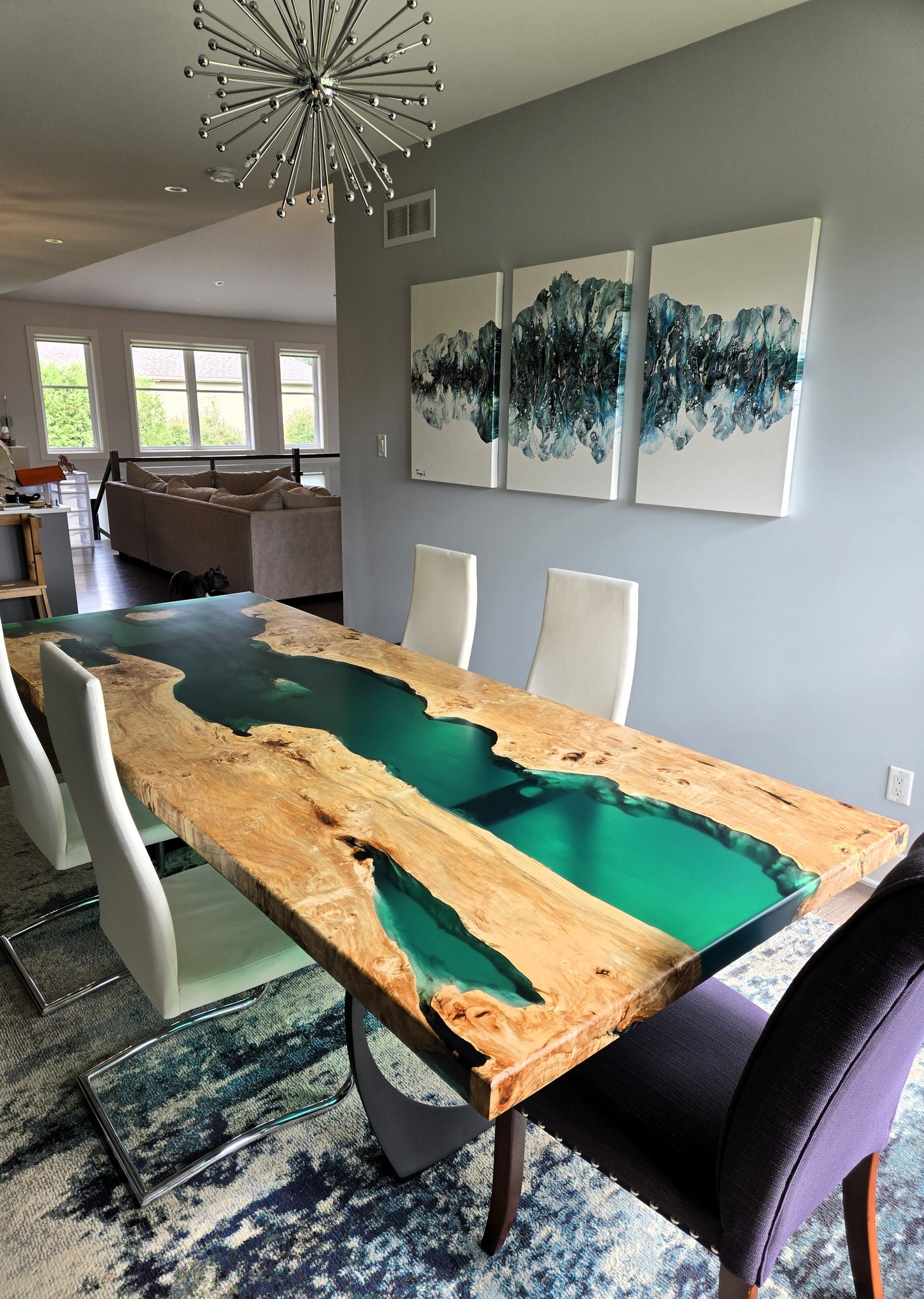
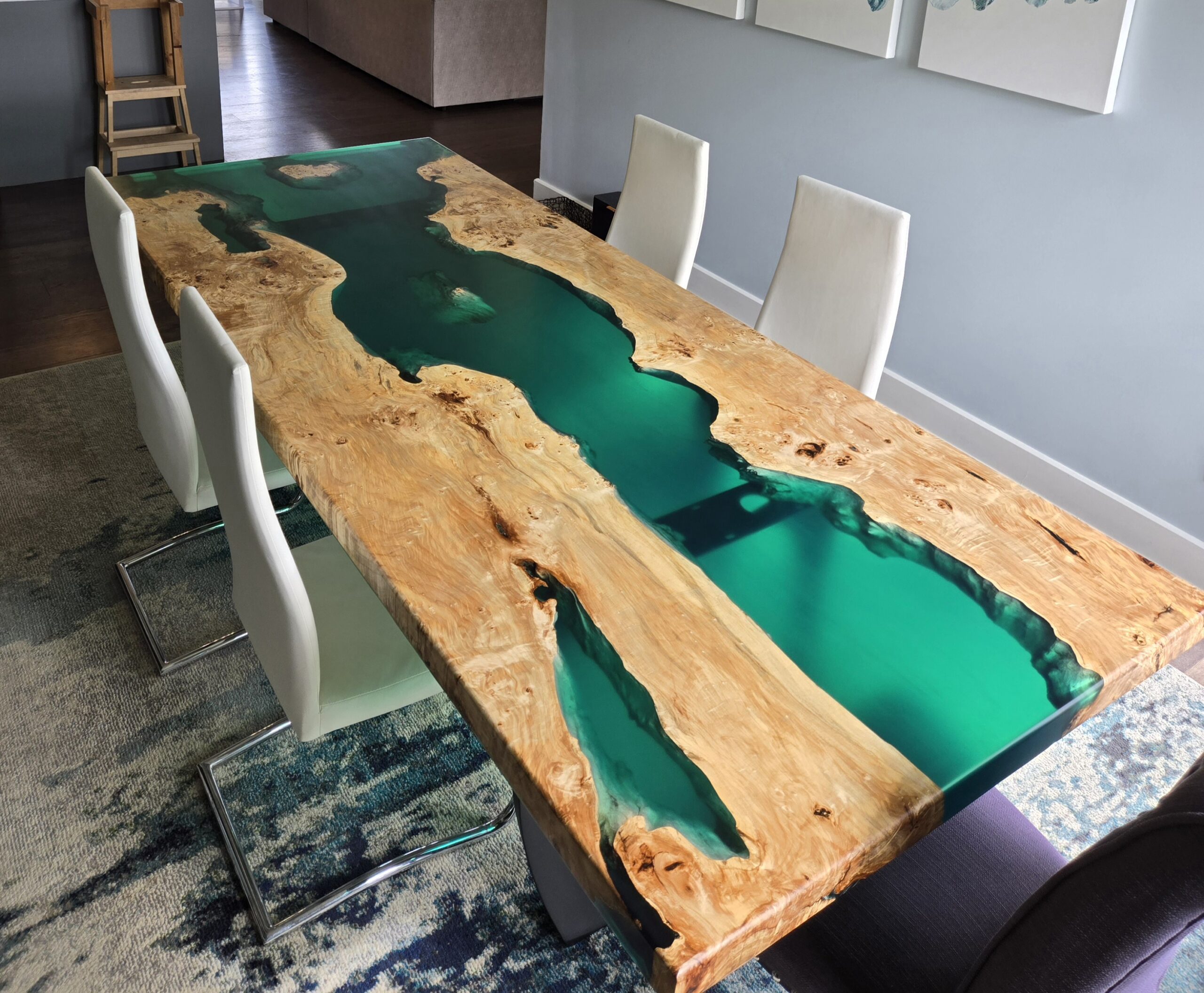
A dramatic live edge or epoxy river table can establish an unmistakable focal point.
This is particularly relevant in newer homes throughout Kanata, Barrhaven, Stittsville, Orléans, and other growing communities around Ottawa.
The table helps communicate where one activity ends and another begins without requiring physical barriers.
Ceiling Height Changes How Furniture Is Perceived
Ceiling height is often overlooked when choosing a dining table.
Yet vertical scale influences how furniture appears within a room.
A large dining area with high ceilings may visually support a table with greater presence. A smaller room with lower ceilings can benefit from proportions that feel lighter and less imposing.
Lighting fixtures also affect this relationship.
A dining table typically sits directly beneath or near pendant lighting or a chandelier. The scale of the tabletop and the fixture should feel connected rather than unrelated.
Custom dimensions allow the table to respond to the room’s vertical as well as horizontal proportions.
Windows Can Become Part of the Composition
Large windows are among the most desirable features in many Canadian homes.
They bring daylight into the dining area and create visual connections with the outdoors.
A custom hardwood table positioned near natural light can become especially striking.
Sunlight reveals subtle characteristics in wood that may be less noticeable under artificial lighting, including:
- Grain direction
- Tonal variations
- Natural figuring
- Surface texture
- Organic markings
Throughout the day, the table can appear slightly different as the direction and intensity of the light change.
Instead of competing with large windows, a thoughtfully designed table can become part of the view.
Flooring Provides Important Design Clues
The relationship between the dining table and flooring is another consideration.
Many Canadian homes feature hardwood flooring, tile, stone, or contemporary engineered surfaces.
A solid wood table does not necessarily need to match a wood floor exactly.
In fact, trying to create an exact match can sometimes make the space feel overly coordinated.
Contrast can be useful.
Different wood tones can coexist successfully when the overall design feels intentional.
The objective is harmony rather than perfect duplication.
A custom finish allows the character of the tabletop to be considered alongside the flooring and other permanent materials within the room.
Straight Architectural Lines Can Inspire Rectangular Tables
Architecture dominated by linear forms often creates a natural setting for rectangular tables.
Long windows, kitchen islands, flooring patterns, cabinetry, and elongated rooms can all establish strong directional lines.
A rectangular table can reinforce these elements.
Its length can follow the architecture and create a sense of continuity through the space.
Natural hardwood prevents the result from feeling overly rigid by introducing grain movement and organic variation within that geometric form.
This balance between structure and nature is one of the reasons rectangular solid wood tables remain so versatile.
Curved Forms Can Change the Energy of a Room
Sometimes the best response to straight architecture is not another straight line.
A round custom table can introduce softness into a room filled with rectangular features.
Kitchen islands, windows, doorways, cabinetry, flooring, and walls are typically dominated by straight lines.
The circular form of a table creates immediate contrast.
This can make the dining area feel more visually distinct while encouraging smoother movement around the perimeter.
For certain homes in Nepean, Rockland, Russell, or Kemptville, a round table can also make effective use of a square or transitional dining area.
Live Edge Tables Introduce Architecture Created by Nature
A live edge can be thought of as nature’s architecture.
Rather than determining every line with tools, the original contour of the hardwood becomes part of the design.
This produces a fascinating relationship between the table and the house.
The building provides controlled geometry.
The wood introduces irregularity.
Together, they can create an interior that feels refined without becoming sterile.
Every live edge is different, which means the resulting relationship with the architecture is also unique.
Epoxy River Tables Can Become Architectural Statements
Some dining areas need more than a table that quietly complements the surroundings.
They need a focal point.
An epoxy river table can provide that visual emphasis.
The combination of natural hardwood and epoxy introduces depth and movement that can immediately attract attention.
In a restrained contemporary interior, this can create an intentional centrepiece.
The surrounding architecture provides the backdrop while the table becomes an individual artistic element within it.
The key is balance.
A successful statement piece should attract attention without making the rest of the room feel irrelevant.
Consider Sightlines Before Finalizing the Design
A table may look completely different depending on where it is viewed from.
From the kitchen, the tabletop may dominate the view.
From a living area, the base may become more visible.
From an upstairs landing, the shape of the tabletop may be particularly noticeable.
These sightlines are worth considering.
A custom table can be designed as a three-dimensional object rather than something intended to look attractive from only one direction.
This becomes increasingly important in open-concept and multi-level Canadian homes.
Architectural Scale Should Influence Table Scale
One of the most common design mistakes in large spaces is selecting furniture that is technically functional but visually undersized.
The opposite problem can occur in compact rooms.
A table may physically fit but dominate the architecture.
Scale is about more than measurements.
It is about visual relationships.
A large window wall, high ceiling, expansive kitchen island, and generous dining area may support a more substantial table.
A smaller defined room may require greater restraint.
Custom craftsmanship allows dimensions to be determined specifically for that environment.
The Base Can Echo or Contrast the Architecture
Table bases provide another opportunity to establish a relationship with the home.
A clean architectural base can complement contemporary interiors.
A visually substantial base may provide balance beneath a thick solid wood tabletop.
The important consideration is that the base should not be selected independently from the rest of the design.
It affects:
- Visual weight
- Legroom
- Chair placement
- Stability
- Overall character
When the tabletop, base, and room architecture are considered together, the finished table feels more cohesive.
Custom Design Does Not Mean Everything Must Match
A beautifully designed interior is rarely created by making every element identical.
Custom craftsmanship provides the opportunity to coordinate without copying.
The table might contrast with the floor.
A live edge might soften linear architecture.
Warm hardwood might balance cool stone surfaces.
A round tabletop might break up a room dominated by rectangles.
These relationships create visual interest.
The goal is not to make the table disappear into the room.
It is to make it feel like it belongs there.
Architecture Varies Throughout Ottawa and Surrounding Communities
One of the interesting aspects of creating custom tables is the diversity of homes throughout the region.
An established Ottawa neighbourhood may contain dining spaces with traditional architectural details.
A newer Kanata, Barrhaven, or Stittsville property may feature an expansive open-concept plan.
Homes in Manotick or Carp may offer larger rooms and stronger connections with the surrounding landscape.
Properties in Nepean, Orléans, Rockland, Russell, and Kemptville bring their own combinations of layouts, finishes, and architectural styles.
The ideal table for each environment can therefore be very different.
That individuality is exactly what custom craftsmanship is designed to address.
Canadian Architecture Continues to Evolve
Homes throughout Canada increasingly combine different architectural influences.
Contemporary construction may incorporate natural materials.
Traditional homes may receive modern renovations.
Open-concept spaces may sit inside older buildings.
Minimalist interiors may include rustic elements.
This blending of styles creates exciting opportunities for custom tables.
Solid hardwood is remarkably adaptable because its appeal is not dependent on a single architectural trend.
It can provide contrast, continuity, warmth, texture, or visual emphasis depending on how it is designed.
A Table Can Connect Different Areas of the Home
In open interiors, the dining table can also help create visual continuity.
Its hardwood may relate to architectural beams or flooring.
Its base may echo darker accents elsewhere in the room.
Its organic edge may complement views of trees outside large windows.
Its proportions may align naturally with the kitchen island.
These connections do not need to be obvious.
Subtle relationships are often what make a room feel thoughtfully composed.
Rough Around the Edges Specializes in Custom Tables
At Rough Around the Edges, we focus exclusively on tables.
Our handcrafted work includes:
- Custom dining tables
- Solid wood tables
- Live edge tables
- Epoxy river tables
- Round tables
- Rectangular tables
- One-of-a-kind custom tables
By concentrating on tables, we can give careful attention to the proportions, natural hardwood character, shape, base, and other details that influence how each piece relates to its environment.
We proudly serve homeowners throughout Ottawa, Kanata, Nepean, Orléans, Barrhaven, Stittsville, Manotick, Carp, Rockland, Russell, Kemptville, and communities across Canada.
The Best Custom Tables Feel Connected to Their Surroundings
A successful custom table does not need to imitate every architectural feature in the home.
It simply needs to understand them.
Sometimes that means reinforcing the room’s lines with a rectangular table.
Sometimes it means introducing the softness of a round design.
A live edge can bring nature into highly structured architecture, while an epoxy river table can provide a bold focal point in an understated space.
Natural hardwood can add warmth where the architecture feels cool or contemporary.
The possibilities depend on the home.
That is the advantage of beginning with a blank page instead of a predetermined table.
The finished piece can respond to the architecture rather than merely occupying it.
Ready to Design a Table That Belongs in Your Home?
If you’re considering a handcrafted custom dining table, solid wood table, live edge table, epoxy river table, round table, or rectangular table, Rough Around the Edges can help create a design that complements the architecture and character of your home.
We proudly serve homeowners throughout Ottawa, Kanata, Nepean, Orléans, Barrhaven, Stittsville, Manotick, Carp, Rockland, Russell, Kemptville, and communities across Canada.
Call Rough Around the Edges at (343) 500-7325 to discuss your space, explore your custom table options, and begin creating a handcrafted centerpiece designed specifically for the home around it.