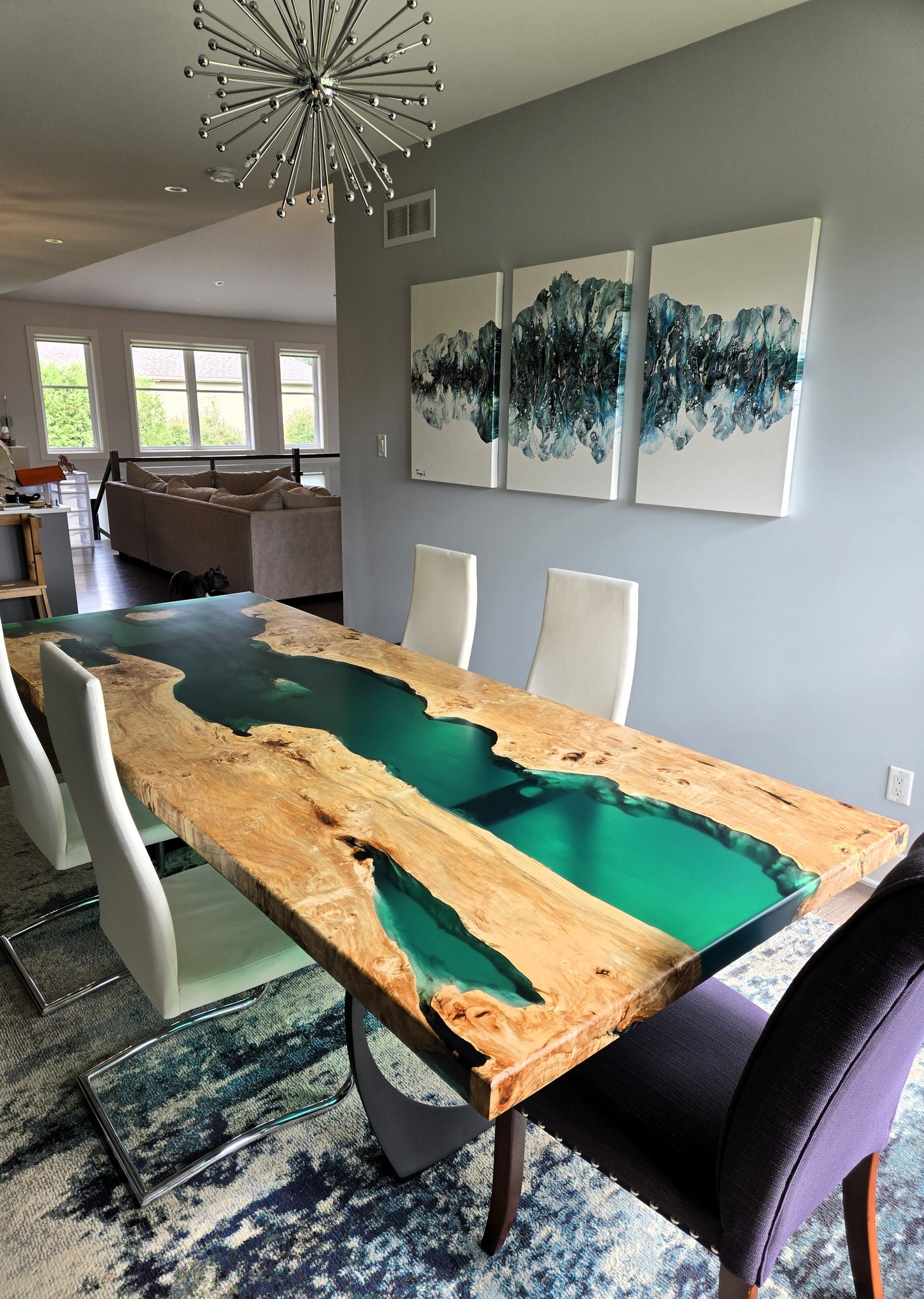


When homeowners begin imagining a handcrafted table, it is natural to think first about appearance. They may picture rich hardwood grain, a dramatic live edge, an epoxy river running through the centre, or a particular finish that complements their dining space.
Those decisions matter, but there is another question worth answering first:
What does the table actually need to do?
A dining table is one of the most active surfaces in a home. It may host breakfast in the morning, homework in the afternoon, dinner in the evening, and guests on the weekend. Some households need generous serving space. Others prioritize comfortable everyday seating. Some want a substantial statement piece, while others need a table that keeps an open-concept room feeling spacious.
At Rough Around the Edges, we specialize exclusively in handcrafted tables. We create custom dining tables, solid wood tables, live edge tables, epoxy river tables, round tables, rectangular tables, and one-of-a-kind custom tables designed around how homeowners actually intend to use them.
Serving Ottawa, Kanata, Nepean, Orléans, Barrhaven, Stittsville, Manotick, Carp, Rockland, Russell, Kemptville, and communities across Canada, we believe the strongest custom designs begin with function and allow beauty to develop alongside it.
Start With an Ordinary Week
It is easy to design a dining table around the biggest dinner of the year.
But what happens during the other 364 days?
Understanding ordinary routines can reveal what a household genuinely needs.
Consider a typical weekday.
Perhaps two people eat breakfast at the table before work. Children return from school and spread out books and laptops. Dinner brings the household together. Later in the evening, someone may use the same surface for paperwork, hobbies, or planning.
By the weekend, the table might host friends or extended family.
A table designed around these routines can be far more satisfying than one selected primarily because a particular style looked attractive in a photograph.
Everyday Seating Should Come First
One of the first questions to consider is how many people normally use the table.
Not occasionally.
Normally.
A household of four that occasionally hosts eight people has different requirements from a household where six or eight people regularly sit together.
Everyday seating affects:
- Table length or diameter
- Width
- Base positioning
- Chair spacing
- Legroom
- Overall room circulation
Custom construction makes it possible to balance regular use with occasional entertaining rather than designing entirely around one scenario.
Think About the People Who Will Actually Sit There
Seating capacity is more than a number.
Six chairs technically fitting around a table does not necessarily mean six people will be comfortable.
The relationship between chairs, table supports, corners, and available personal space matters.
For a family dining table, comfortable spacing can make everyday meals noticeably more enjoyable.
This is especially important when a table will remain in the home for many years. Children grow. Household routines change. Different chairs may eventually be introduced.
Thoughtful proportions give the table greater flexibility.
Consider How Much Surface Space You Really Use
Some households prefer a relatively uncluttered tabletop.
Others regularly place large serving dishes, centrepieces, pitchers, condiments, and multiple place settings on the table.
That difference matters when determining width.
A narrow table may be appropriate in a limited dining space, but households that regularly serve meals family-style may appreciate additional central space.
At the same time, making a table unnecessarily wide can create too much distance between people sitting opposite one another.
The objective is not simply to maximize surface area.
It is to create the right amount of surface area.
Do You Entertain Frequently?
Entertaining changes how a table functions.
Homeowners who regularly invite family and friends may prioritize generous seating and serving space.
The dining table may become the centre of:
- Holiday meals
- Birthday dinners
- Weekend gatherings
- Celebrations
- Casual entertaining
- Special occasions
For homes in Ottawa, Manotick, Stittsville, Barrhaven, and surrounding communities, the dining area may also connect directly with a kitchen or outdoor entertaining space.
Understanding how guests move through those areas can influence table dimensions and placement.
A custom table can be designed to accommodate entertaining without making everyday use feel unnecessarily oversized.
Will the Table Double as a Workspace?
Remote and hybrid work have changed how many Canadian households use their dining areas.
A table may now serve as an occasional workspace even when a dedicated home office exists.
Laptops, notebooks, chargers, paperwork, and video meetings can temporarily turn a dining surface into a productive work area.
The same is true for students.
Homework, school projects, and studying often migrate to the dining table because it provides a large central surface.
If this is part of the household’s routine, it should be considered during design.
A substantial solid wood tabletop can provide generous working space while still returning naturally to its primary dining role when the workday ends.
Families With Children Use Tables Differently
For families, the dining table often becomes one of the hardest-working surfaces in the house.
It may be used for:
- Drawing
- Crafts
- Homework
- Baking projects
- Board games
- Puzzles
- Family meals
A table intended for this kind of everyday life should not be designed as though nobody will ever touch it.
Material selection, finishing, dimensions, and overall construction should reflect the reality that the table will be actively used.
At Rough Around the Edges, we believe a handcrafted table should become part of life in the home—not an object everyone is afraid to enjoy.
Round Tables Encourage a Different Type of Interaction
Table shape affects more than appearance.
A round table creates a centralized seating arrangement where everyone faces toward the middle.
This can create an intimate atmosphere for conversation and shared meals.
Round tables can be particularly effective for households that:
- Prefer conversational dining
- Have square dining rooms
- Need smoother movement around the table
- Want to avoid prominent corners
- Prefer a softer visual shape
However, the correct diameter is essential.
A custom round table can be proportioned according to the number of people who regularly use it and the room where it will be placed.
Rectangular Tables Offer Flexible Surface Area
A rectangular table provides a different experience.
Its elongated shape works naturally in many dining rooms and open-concept spaces throughout Ottawa and Canada.
For larger households or people who entertain frequently, rectangular tables can provide generous seating while maintaining a practical relationship between width and length.
They also showcase long sections of hardwood beautifully.
Natural grain can travel across the tabletop, turning the material itself into a major visual feature.
Custom dimensions allow the length and width to respond specifically to household needs rather than following standardized proportions.
Live Edge Isn’t Only About Appearance
A live edge table is immediately recognizable because of its organic perimeter.
But choosing live edge should also involve considering how the table will be used and positioned.
The natural contours create variation along the edge, meaning the tabletop does not have exactly the same width at every point.
That individuality is part of its appeal.
It also means the slab itself becomes an important part of the design process.
The objective is to create a table where the natural character of the wood and practical dining requirements work together.
Epoxy River Tables Can Combine Function With Art
An epoxy river table often begins with a desire for something distinctive.
The contrast between natural hardwood and epoxy can create an extraordinary visual centerpiece.
However, a successful epoxy table should still perform comfortably as a dining surface.
Dimensions, seating, base placement, room circulation, and everyday use remain just as important.
Artistic impact and functionality do not need to compete.
With thoughtful design, they can support one another.
Think About How the Room Is Used Beyond Dining
The table does not exist in isolation.
Its surroundings matter.
An open-concept dining area may sit between the kitchen and living room. Another dining room may provide access to a patio. A table might be positioned near a major hallway or beside a kitchen island.
Before deciding on dimensions, consider how people use the entire area.
Ask questions such as:
- Where do people normally walk?
- Which doors need clear access?
- How far do chairs move backward?
- Is the dining area part of a major pathway?
- Does the table need to visually define an open space?
These practical details can significantly influence the final design.
Base Design Affects Everyday Function
The base of a table is not simply decorative.
It directly influences where people can sit.
Poorly positioned legs or supports can interfere with knees, chairs, and comfortable seating positions.
This becomes particularly important when trying to accommodate more people around the table.
A custom design allows the base to be considered alongside:
- Table dimensions
- Seating layout
- Structural requirements
- Visual proportions
- Legroom
The best base is one that contributes to the design while supporting comfortable everyday use.
Think About Cleaning and Daily Maintenance
A table that is used constantly needs to fit comfortably into the household’s routines.
Dining surfaces inevitably encounter crumbs, spills, fingerprints, serving dishes, and everyday activity.
The goal should not be to create a table that homeowners feel compelled to protect from normal life.
Instead, the design and finish should support realistic use and appropriate care.
Understanding how the household lives with the table can help guide decisions during the custom process.
Canadian Seasons Are Part of the Conversation
Solid hardwood is a natural material.
It responds to changes in humidity, including those experienced throughout the seasons in Ottawa and across Canada.
Thoughtful woodworking accounts for natural wood movement as part of the construction process.
This is important because a custom table should be considered over years of use—not simply on the day it arrives in the home.
Properly designed solid wood furniture respects the characteristics of the material rather than treating hardwood as though it were synthetic and completely static.
Lifestyle Should Influence Style
Once the practical requirements are understood, aesthetic decisions become easier.
A household may discover that a substantial rectangular table best supports frequent entertaining.
Another may realize that a custom round table creates better circulation.
A homeowner seeking strong natural character may choose live edge hardwood.
Someone wanting an artistic focal point may be drawn toward an epoxy river table.
Function does not limit creativity.
It provides a foundation for it.
Custom Means Fewer Compromises
Standard furniture requires homeowners to select from existing combinations.
A particular table might have the right length but the wrong width.
Another may have an attractive top but a base that interferes with seating.
A round table may be close to the right diameter but slightly too large for comfortable circulation.
Custom craftsmanship provides an opportunity to address these details individually.
The objective isn’t customization simply for the sake of being different.
It is customization with purpose.
Different Canadian Homes Need Different Tables
A dining space in a Kanata family home may require something completely different from a property in Manotick.
A compact room in Nepean may benefit from carefully controlled dimensions, while a larger open-concept home in Stittsville may need greater visual presence.
Homes in Orléans, Barrhaven, Carp, Rockland, Russell, and Kemptville each present their own combination of architecture and lifestyle.
That diversity is precisely why one standard table cannot be ideal for every household.
Handcrafted Custom Tables From Rough Around the Edges
At Rough Around the Edges, our focus is tables.
We create:
- Custom dining tables
- Solid wood tables
- Live edge tables
- Epoxy river tables
- Round tables
- Rectangular tables
- Handcrafted one-of-a-kind tables
Every project is an opportunity to combine beautiful natural materials with practical design.
We proudly serve homeowners throughout Ottawa, Kanata, Nepean, Orléans, Barrhaven, Stittsville, Manotick, Carp, Rockland, Russell, Kemptville, and communities across Canada.
Design the Table Around Life First
There are countless exciting decisions involved in creating a custom table.
Wood character matters.
Shape matters.
Edges matter.
Finishes matter.
Bases matter.
But before making any of those choices, homeowners can benefit from thinking about what actually happens around the table.
Who sits there?
How often is it used?
What happens there besides dinner?
How frequently do guests visit?
How much serving space is useful?
How does everyone move around the room?
Answering those questions creates a stronger foundation for every design decision that follows.
A beautiful custom table should attract attention when someone enters the room.
But when people sit down, it should also make everyday life feel completely natural.
Ready to Design a Table Around the Way You Live?
If you’re considering a handcrafted custom dining table, solid wood table, live edge table, epoxy river table, round table, or rectangular table, Rough Around the Edges can help create a design based on your home and the way your household actually uses the space.
We proudly serve Ottawa, Kanata, Nepean, Orléans, Barrhaven, Stittsville, Manotick, Carp, Rockland, Russell, Kemptville, and communities throughout Canada.
Call Rough Around the Edges at (343) 500-7325 to discuss your ideas and begin creating a custom table where craftsmanship, natural hardwood, and everyday functionality come together.