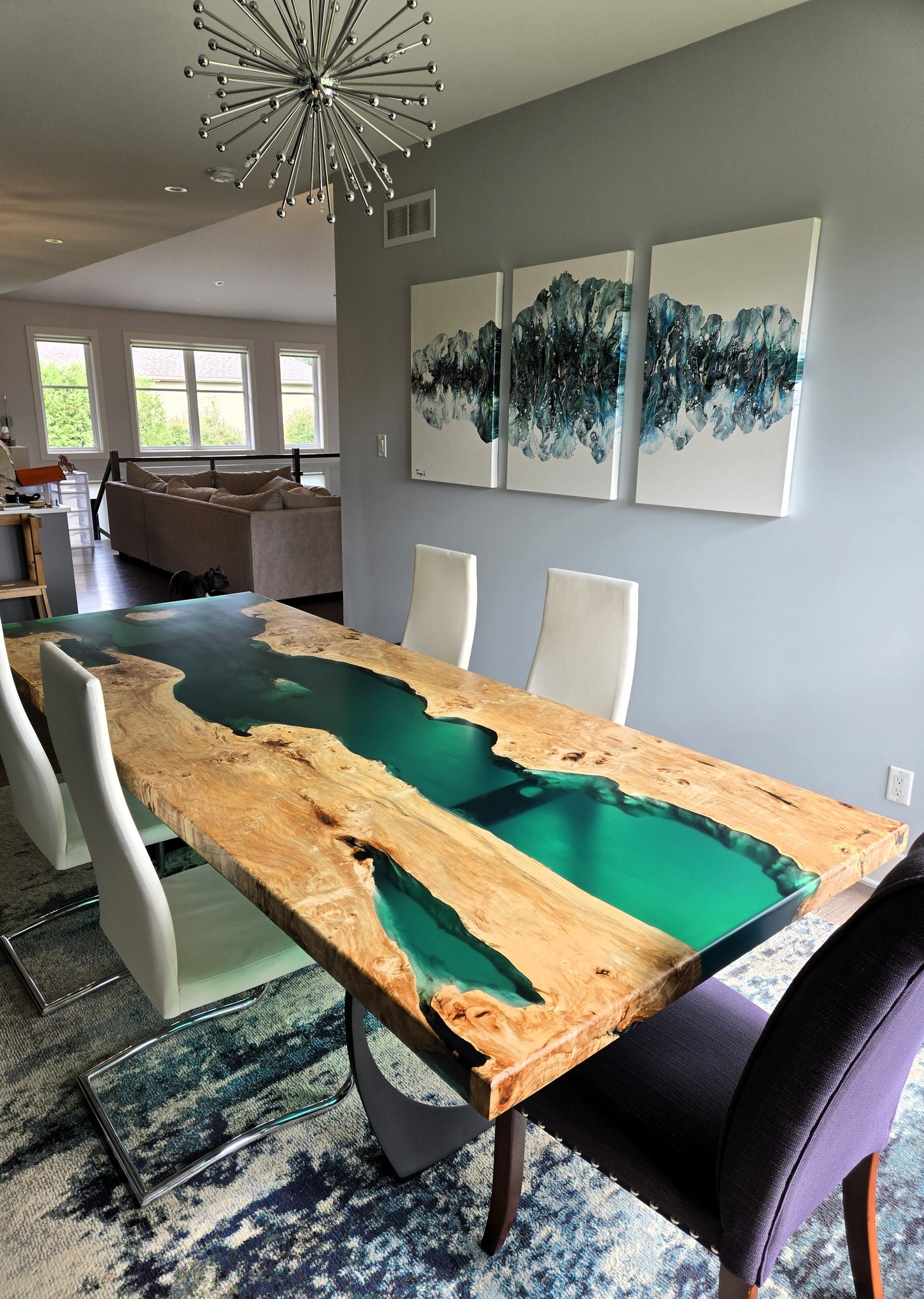

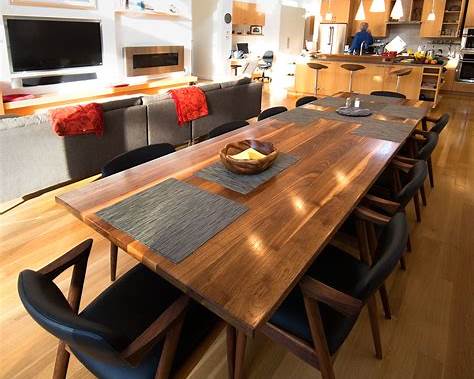
Not every dining room is a perfect rectangle with generous space on every side. Real homes have architectural features that make furnishing them more interesting: narrow rooms, unusual corners, kitchen islands, patio doors, large windows, walkways, open-concept layouts, and spaces that need to serve more than one purpose.
This is where a standard-size table can become frustrating.
A table may technically fit according to its measurements but still interfere with a doorway. Another may provide enough seating but leave too little room to walk behind the chairs. A beautiful table might even look surprisingly small because its proportions do not suit a large open-concept space.
At Rough Around the Edges, we specialize exclusively in handcrafted tables. Our custom dining tables, solid wood tables, live edge tables, epoxy river tables, round tables, and rectangular tables can be designed around the realities of the room rather than forcing the room to accommodate predetermined furniture dimensions.
For homeowners throughout Ottawa, Kanata, Nepean, Orléans, Barrhaven, Stittsville, Manotick, Carp, Rockland, Russell, Kemptville, and communities across Canada, custom table design can turn a challenging dining area into a space that feels intentional, comfortable, and beautifully balanced.
The Room Doesn’t Have to Be Perfect
One of the advantages of custom design is simple: the dining room does not need to conform to standard furniture sizes.
Homes are different.
Even properties with similar square footage can have completely different dining layouts because of windows, doorways, kitchens, staircases, and architectural design.
Instead of asking, “Which standard table will fit?”, homeowners can ask a much more useful question:
“What table should be created for this particular space?”
That shift opens significantly more possibilities.
Start With How People Move Through the Space
Dining room planning is not only about where the table sits.
It is also about everything happening around it.
People need to:
- Pull chairs away from the table
- Sit comfortably
- Walk behind seated guests
- Move between rooms
- Access doors
- Reach adjoining spaces
- Carry food from the kitchen
A table can look appropriately sized when the room is empty but feel completely different once chairs and people are added.
That is why circulation should be considered during the design stage.
A thoughtfully proportioned custom table helps preserve comfortable movement without unnecessarily sacrificing useful tabletop or seating space.
Narrow Dining Rooms Need Careful Width Planning
Narrow dining rooms can present a particularly interesting challenge.
The temptation is often to focus entirely on table length because homeowners want to accommodate enough people.
However, width may be the more important measurement.
An excessively wide tabletop can reduce walking space and make pulling out chairs difficult. A table that is too narrow, on the other hand, may not provide enough comfortable room for dining and serving.
Custom construction allows the width to be considered specifically for the room.
Instead of accepting a predetermined combination of length and width, the proportions can be adjusted to create a better balance.
This can be especially useful in established Ottawa and Nepean homes where dining spaces may have architectural dimensions very different from newer open-concept properties.
Open-Concept Homes Present the Opposite Challenge
Large open-concept spaces can create another problem: a table that looks substantial in a showroom may suddenly appear undersized once it enters the home.
When the dining area shares visual space with the kitchen and living room, the table needs enough presence to establish the dining zone.
Proportion becomes extremely important.
A custom rectangular solid wood table can create a strong visual anchor, while a carefully designed round table can establish a defined gathering area without introducing additional straight lines.
Homes in communities such as Kanata, Barrhaven, Stittsville, and other growing areas around Ottawa frequently feature open-concept layouts where this type of proportional planning can make a significant difference.
Kitchen Islands Affect Dining Table Placement
Modern kitchens often feature large islands.
These are excellent for preparation, casual seating, and entertaining, but they also influence the dining area.
A dining table positioned too close to an island can create congestion, particularly when stools and dining chairs are occupied simultaneously.
The relationship between these two surfaces deserves careful consideration.
Table dimensions and placement can be planned around:
- Island size
- Stool clearance
- Kitchen traffic
- Dining chair movement
- Walkways
- Sightlines
Custom sizing provides greater control over this relationship.
Instead of squeezing a standard table into the remaining area, the table can be proportioned around how the entire space functions.
Patio Doors Can Change Everything
A beautiful set of patio doors can fill a dining area with natural light, but those doors also require unobstructed access.
This is particularly important in Canadian homes where decks, patios, and outdoor entertaining areas may become extensions of the dining space during warmer seasons.
A table positioned too close to the doors can create an awkward bottleneck.
Homeowners may constantly move around chairs or ask guests to shift whenever someone wants to go outside.
Thoughtful table dimensions can preserve that access while still maximizing useful dining space.
For homes in Manotick, Carp, Rockland, Russell, and Kemptville, where indoor-outdoor living may be an important part of the property, these practical details deserve attention.
Windows Influence More Than Lighting
Large windows are another feature that can affect table design.
They influence sightlines, furniture placement, and how natural light interacts with the hardwood.
A custom table can be positioned and proportioned to work with these architectural elements rather than compete with them.
There is also a visual benefit.
Natural daylight can beautifully reveal the grain, texture, and tonal variations of solid wood.
As sunlight changes throughout the day, different areas of the tabletop may become more prominent.
This interaction between architecture, natural light, and hardwood can become part of the overall dining experience.
Round Tables Can Solve Certain Layout Challenges
A custom round table can be an excellent solution for rooms where corners would otherwise interfere with movement.
Its continuous curved perimeter may create smoother circulation, particularly in:
- Square dining rooms
- Smaller dining areas
- Spaces near walkways
- Rooms with multiple entrances
- Breakfast areas
Round tables also create a distinctive visual experience.
Rather than establishing a strong linear direction, they create a centralized focal point.
However, diameter matters.
A table that is too small may not accommodate the household comfortably, while an excessively large round table can make reaching the centre inconvenient.
Custom design allows the diameter and base to be planned together for the intended space and seating needs.
Rectangular Tables Work With Long Spaces
In elongated rooms, a rectangular table often creates a natural relationship with the architecture.
Its length follows the room and can make efficient use of available space.
But not every rectangular table needs conventional proportions.
A custom table can be made narrower, wider, shorter, or longer according to the room.
This flexibility is particularly helpful when a dining space needs substantial seating but has limited width.
The base can also be positioned with seating and legroom in mind rather than simply following standardized manufacturing requirements.
Base Placement Is Crucial in Challenging Rooms
The tabletop receives most of the attention when people discuss table dimensions, but the base can have an equally significant effect on usability.
Poorly positioned supports can interfere with chairs or reduce the number of comfortable seating positions.
This becomes especially noticeable when homeowners are trying to maximize seating in a limited space.
A custom table allows the relationship between the top, base, and seating arrangement to be considered as one complete design.
A beautiful table should not only fit the room.
People should fit comfortably around it.
Live Edge Can Soften Difficult Architecture
Rooms containing many straight architectural lines can sometimes feel visually rigid.
A live edge table introduces organic movement through the natural contour of the hardwood.
The contrast can be especially effective in contemporary Canadian interiors featuring:
- Straight cabinetry
- Large windows
- Linear flooring
- Geometric lighting
- Minimalist architecture
Rather than adding another perfectly straight surface, the live edge creates natural variation.
It can make a challenging room feel more visually interesting without requiring additional decoration.
Epoxy River Tables Can Create a Strong Focal Point
Some awkward dining areas benefit from embracing their uniqueness rather than attempting to disguise it.
An epoxy river table can create a deliberate focal point that gives the dining area a strong identity.
Natural hardwood provides warmth and organic character, while epoxy introduces visual depth and contrast.
Because every slab and epoxy composition is different, the table becomes an individual design rather than something selected simply because its dimensions happened to fit.
In an unconventional room, that individuality can become an advantage.
Small Dining Spaces Don’t Necessarily Need Small Ideas
Limited square footage does not mean homeowners have to settle for an unremarkable dining area.
In fact, careful design becomes even more important when every centimetre matters.
A custom table can help make more effective use of the available space by considering:
- Exact dimensions
- Seating requirements
- Chair clearance
- Walkways
- Base positioning
- Table shape
Instead of purchasing an undersized table simply to guarantee clearance, homeowners can create proportions that maximize the room intelligently.
Large Rooms Need Thoughtful Planning Too
More space does not automatically make furniture selection easier.
A dining table that is too small can appear disconnected in a large room.
Conversely, making a table extremely large simply because space is available can create unnecessary distance between people and make everyday dining less comfortable.
The objective should be balance.
The table should have enough visual presence for the architecture while remaining practical for regular use.
Custom design makes it possible to find that balance rather than selecting the largest available option.
Solid Wood Adds Warmth to Architectural Spaces
Unusual layouts often contain strong architectural features.
Natural hardwood can help soften those spaces.
The grain, colour variation, knots, and organic character of solid wood introduce warmth that contrasts beautifully with glass, metal, stone, tile, and other common materials found in modern Canadian homes.
A custom solid wood table therefore does more than solve a dimensional challenge.
It can help visually connect different parts of an open or unconventional interior.
Measure for Real Life, Not an Empty Room
One of the most useful principles when planning a custom table is to imagine the room while it is actually being used.
Where will the chairs be when someone is seated?
Can another person walk behind them?
Which doorway receives the most traffic?
Does someone regularly move between the kitchen and dining area?
Will the patio door be used frequently?
How many people typically sit at the table?
How many need to fit during larger gatherings?
These practical questions often reveal more than room dimensions alone.
A table should be designed around the household’s real routines.
Challenging Spaces Can Produce the Most Interesting Tables
An unusual room does not necessarily represent a limitation.
Sometimes it provides the reason to create something more thoughtful.
A narrow dining room may inspire beautifully refined proportions.
An open-concept home may call for a substantial solid wood centerpiece.
A square room might be transformed by a custom round table.
A contemporary interior could benefit from the organic movement of a live edge.
A distinctive space might be the perfect setting for an epoxy river design.
Custom craftsmanship allows architecture to influence the table rather than forcing every home to work with the same standardized solution.
Custom Tables for Ottawa and Communities Across Canada
At Rough Around the Edges, tables are our specialty.
We create handcrafted:
- Custom dining tables
- Solid wood tables
- Live edge tables
- Epoxy river tables
- Round tables
- Rectangular tables
- One-of-a-kind custom tables
We proudly work with homeowners throughout Ottawa, Kanata, Nepean, Orléans, Barrhaven, Stittsville, Manotick, Carp, Rockland, Russell, Kemptville, and communities across Canada.
Whether the dining area is compact, spacious, narrow, open-concept, unusually shaped, or simply difficult to furnish, custom construction provides the opportunity to create a table specifically for that environment.
The Best Table Isn’t Always a Standard Size
Dining spaces are as individual as the homes surrounding them.
That is why an awkward layout does not have to be treated as a problem.
With careful consideration of proportions, circulation, seating, architectural features, table shape, and base placement, a custom table can turn a challenging room into one of the home’s most successful spaces.
Instead of compromising because standard dimensions do not quite work, homeowners can create something designed around the room from the beginning.
The result is not merely a table that fits.
It is a table that makes the entire dining space work better.
Ready to Create a Table for Your Unique Space?
If your dining room has an unusual layout—or you simply want a table designed precisely for your home—Rough Around the Edges can create a handcrafted solution around your space and lifestyle.
We specialize in custom dining tables, solid wood tables, live edge tables, epoxy river tables, round tables, and rectangular tables for homeowners throughout Ottawa, Kanata, Nepean, Orléans, Barrhaven, Stittsville, Manotick, Carp, Rockland, Russell, Kemptville, and communities across Canada.
Call Rough Around the Edges at (343) 500-7325 to discuss your dining space and begin designing a handcrafted custom table created specifically for the way your home looks, flows, and functions.