
When planning a custom dining table, homeowners often focus first on length.
How many people can sit along the sides?
Will there be enough room at the ends?
How long should the table be for family gatherings?
Those are important questions, but there is another measurement that has just as much influence on comfort and usability: table width.
A dining table can be beautifully crafted and still feel awkward if it is too narrow or too wide for the way the household uses it. Width affects serving space, conversation, chair placement, room circulation, and even how balanced the table looks within the dining area.
At Rough Around the Edges, we specialize exclusively in handcrafted tables, including custom dining tables, solid wood tables, live edge tables, epoxy river tables, round tables, rectangular tables, and one-of-a-kind custom tables.
We proudly serve homeowners throughout Ottawa, Kanata, Nepean, Orléans, Barrhaven, Stittsville, Manotick, Carp, Rockland, Russell, Kemptville, and communities across Canada.
Understanding table width can help homeowners create a custom piece that works beautifully for both everyday meals and larger gatherings.
Table Width Is About More Than Surface Area
At first glance, width may seem like a simple question of how much room is available for plates and serving dishes.
But it affects much more than that.
A table that is too narrow can feel crowded when meals are served family-style.
A table that is too wide can make conversation across the table feel less natural.
Width also influences:
- Overall room proportions
- Chair clearance
- Centrepiece space
- Serving space
- Visual balance
- How substantial the table feels
This is why width should be planned together with length, not treated as a secondary detail.
Think About How Meals Are Actually Served
Some households prefer simple place settings and minimal items on the table.
Others regularly place:
- Serving bowls
- Platters
- Bread baskets
- Drinks
- Condiments
- Centrepieces
This difference matters.
If the table is used for family-style meals, extra central space can make dining more comfortable.
At the same time, excessive width can create unnecessary distance between people seated opposite one another.
The ideal width balances both needs.
Conversation Should Still Feel Natural
Dining tables are social spaces.
People gather around them not only to eat but also to talk.
That means the distance between opposite seats matters.
A table that is too wide can make conversations feel less connected, especially during smaller everyday meals.
For households that value casual family dining, a comfortable conversational distance can be just as important as having generous surface space.
Custom sizing allows homeowners to find a width that supports both serving and connection.
Narrow Rooms Need Special Attention
Some dining rooms are naturally long and narrow.
In these spaces, homeowners may be tempted to choose a wide table because it appears more substantial.
But an overly wide table can quickly reduce circulation.
Chairs need room to move.
People need space to walk behind them.
Doorways and walkways should remain accessible.
For homes in Ottawa, Nepean, and other established communities where dining rooms may have more defined dimensions, custom width can make a significant difference.
A slightly narrower custom table may provide the same seating capacity while improving movement throughout the room.
Open-Concept Homes Create Different Opportunities
In larger open-concept spaces, homeowners may have more flexibility.
A wider table can create stronger visual presence and additional serving space.
This can work especially well in homes throughout Kanata, Barrhaven, Stittsville, and Orléans, where dining areas often sit between the kitchen and living room.
However, even in a large room, width should be proportional.
The goal is not simply to create the biggest possible surface.
It is to create a table that feels balanced within the architecture.
Rectangular Tables Depend Heavily on Width
A rectangular custom dining table can vary dramatically depending on its proportions.
A long, narrow table creates a very different experience from a shorter, wider one.
A narrower rectangular table may feel more streamlined and efficient.
A wider one can create a more generous and substantial presence.
The correct ratio depends on:
- Room shape
- Seating needs
- Hosting habits
- Serving style
- Overall design preferences
Custom construction makes it possible to control this relationship precisely.
Live Edge Tables Naturally Vary in Width
A live edge table introduces another consideration.
Because the natural contours of the hardwood are preserved, the tabletop may not maintain exactly the same width from one end to the other.
That variation is part of its appeal.
Instead of a perfectly uniform rectangle, the table retains the organic character of the wood.
For homeowners choosing live edge craftsmanship, average usable width becomes especially important.
The design should preserve natural beauty while still providing practical dining space.
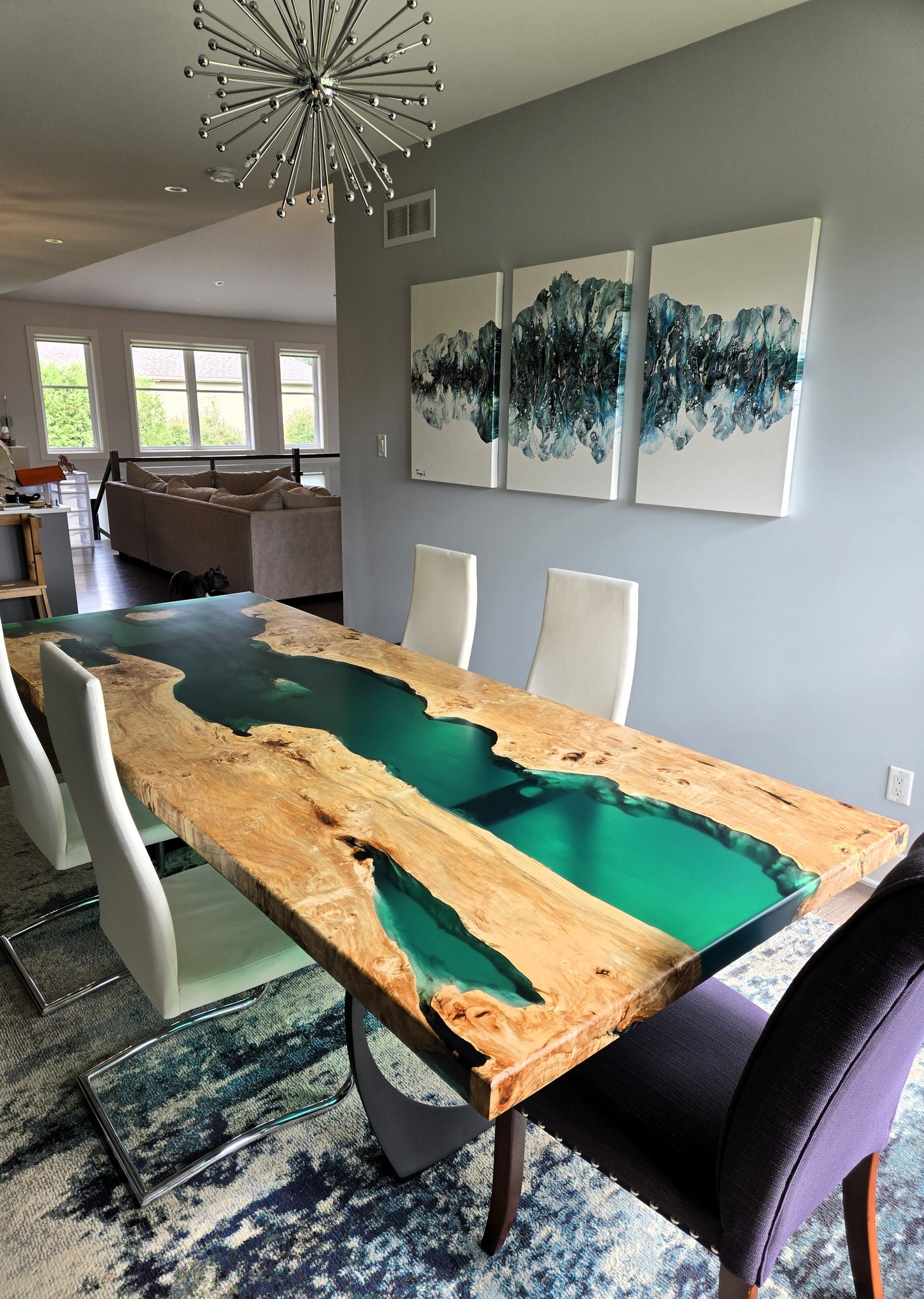
Epoxy River Tables Use Width as Part of the Composition
In an epoxy river table, the relationship between the hardwood slabs and the epoxy feature is influenced by overall table width.
A wider table may create more room for a visually dramatic river feature.
A narrower design may create a more refined and understated appearance.
The balance between wood and epoxy should feel intentional.
The table still needs to function comfortably as a dining surface while maintaining the artistic character that makes epoxy river tables unique.
Wider Tables Can Showcase Hardwood Beautifully
One advantage of additional width is the opportunity to display more natural grain.
A broad solid wood surface can reveal:
- Sweeping grain movement
- Natural knots
- Tonal variation
- Organic markings
- Distinctive figure
For homeowners who want the hardwood itself to become the focal point, additional width can make that character more visible.
This can be particularly striking in larger homes in Manotick, Carp, Russell, or Kemptville.
But More Wood Is Not Always Better
A larger surface may sound appealing, but design should remain practical.
Extra width increases:
- Visual weight
- Physical footprint
- Distance across the table
- Space required in the room
A table should not become oversized simply because custom craftsmanship allows it.
The best dimensions support how the household actually lives.
Chair Placement Should Be Part of the Decision
Width also affects how dining chairs relate to the table.
A wider tabletop can make the entire arrangement feel more substantial.
That may pair beautifully with larger upholstered chairs.
A narrower table can create a lighter composition, especially when paired with refined seating.
The table and chairs do not need to match perfectly, but their proportions should feel compatible.
Kitchen Islands Can Limit Practical Width
In open-concept homes, the dining table often sits near a kitchen island.
This is where width becomes especially important.
A wide table may reduce the space between dining chairs and island stools.
During gatherings, this can create congestion.
Homeowners should consider the dining table and kitchen island as parts of the same environment.
Custom dimensions can help preserve comfortable circulation between them.
Patio Doors and Walkways Matter Too
The dining area may also provide access to:
- Patio doors
- Decks
- Hallways
- Living spaces
- Kitchens
A table can technically fit and still interfere with these pathways.
This is another reason the room should be considered in active use rather than empty.
When people pull chairs back and move through the space, the practical width of the table becomes much more obvious.
Table Width Changes the Visual Personality
Two tables with the same length can feel completely different if their widths are different.
A narrow table may appear:
- Sleek
- Refined
- Linear
- Contemporary
A wider table may feel:
- Substantial
- Grounded
- Luxurious
- Architectural
Neither effect is inherently better.
It depends on the desired character of the room.
Wider Tables Can Create Stronger Statement Pieces
For homeowners who want the dining table to become the dominant feature in a large room, extra width can add visual presence.
A broad solid wood tabletop naturally attracts attention.
This can work beautifully in:
- Large dining rooms
- Open-concept homes
- High-ceiling spaces
- Homes with expansive windows
The table becomes more than a dining surface.
It becomes an architectural focal point.
Narrower Tables Can Feel Elegant and Efficient
In contrast, a narrower table can create a more refined experience.
This can be ideal for:
- Compact dining rooms
- Urban homes
- Long narrow spaces
- Minimalist interiors
The table still provides handcrafted quality without overwhelming the room.
For many Ottawa homes, this balance can make the dining area feel more comfortable and spacious.
Width Should Support Everyday Use First
Holiday hosting and larger gatherings matter, but everyday routines should remain the priority.
A household may host twelve people only a few times each year.
The rest of the time, the table might serve four or six.
The ideal width should feel comfortable during both situations.
Custom design makes it possible to avoid extremes.
Canadian Homes Require Flexible Thinking
Homes throughout Canada vary enormously in size and layout.
A contemporary home in Kanata may support a broad statement table.
A defined dining room in Nepean may benefit from a more controlled width.
A larger property in Manotick or Carp may offer generous space for substantial proportions.
Homes in Barrhaven, Stittsville, Orléans, Rockland, Russell, and Kemptville each present different architectural opportunities.
There is no universal ideal width.
There is only the width that works best for the home.
Rough Around the Edges Specializes Exclusively in Tables
At Rough Around the Edges, we focus entirely on handcrafted custom tables.
We create:
- Custom dining tables
- Solid wood tables
- Live edge tables
- Epoxy river tables
- Round tables
- Rectangular tables
- One-of-a-kind custom tables
We proudly serve homeowners throughout Ottawa, Kanata, Nepean, Orléans, Barrhaven, Stittsville, Manotick, Carp, Rockland, Russell, Kemptville, and communities across Canada.
Every table is designed around its future home and the people who will use it.
The Right Width Makes Everyday Dining Feel Easier
Table width may not be the first measurement homeowners think about.
But it influences almost every part of the dining experience.
It affects serving.
Conversation.
Movement.
Room balance.
Chair placement.
Visual presence.
And overall comfort.
A well-designed custom table should provide enough space without creating unnecessary distance or crowding the room.
That balance is what turns dimensions into good design.
Ready to Find the Right Dimensions for Your Custom Table?
If you are considering a handcrafted custom dining table, solid wood table, live edge table, epoxy river table, round table, or rectangular table, Rough Around the Edges can help determine proportions that work beautifully for your home.
We proudly serve Ottawa, Kanata, Nepean, Orléans, Barrhaven, Stittsville, Manotick, Carp, Rockland, Russell, Kemptville, and communities throughout Canada.
Call Rough Around the Edges at (343) 500-7325 to discuss your room, seating needs, and design ideas and begin creating a custom table with dimensions made specifically for the way you live.